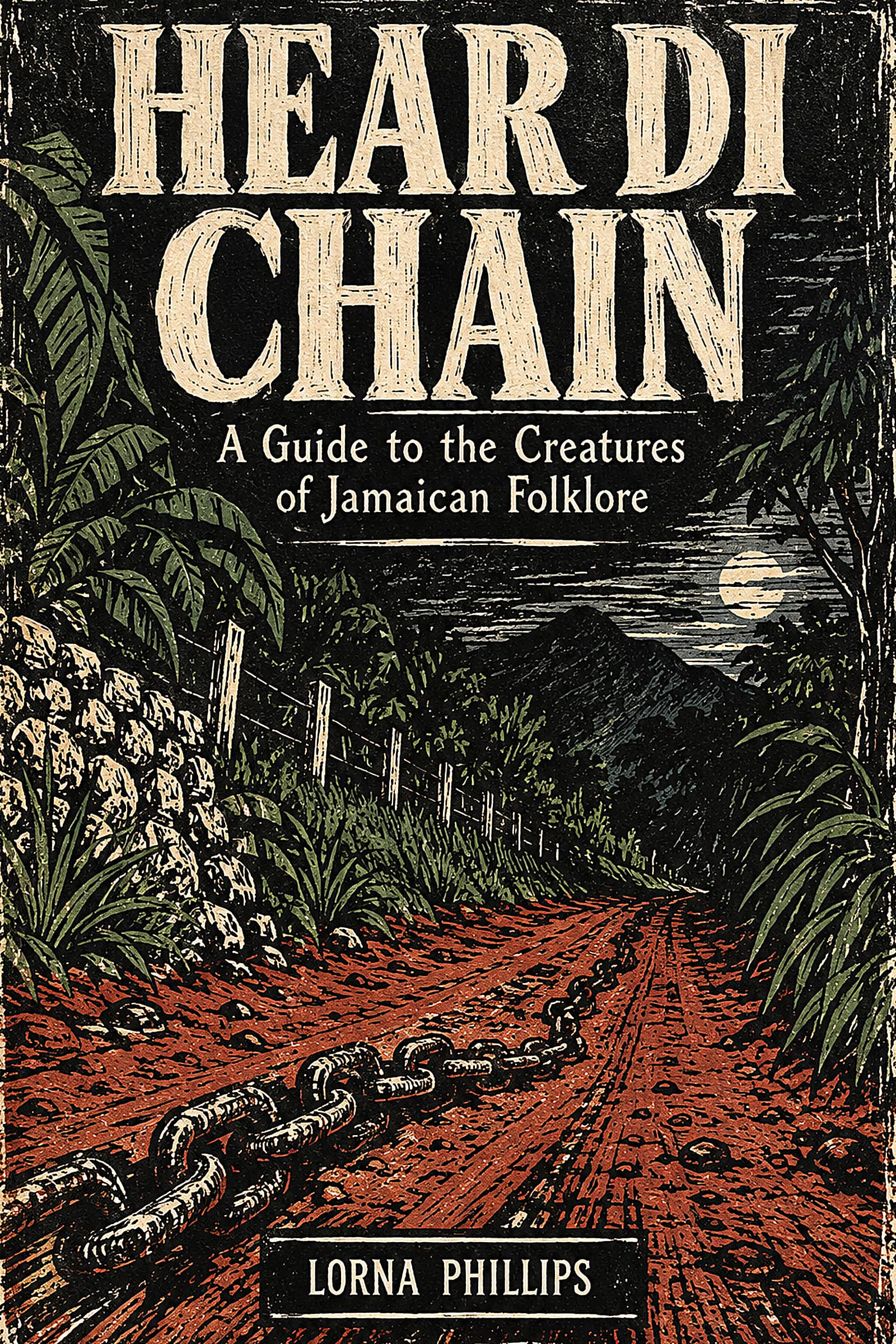
Hear Di Chain
A Guide to the Creatures of Jamaican Folklore
Yuh hear di chain first. Yuh nuh see it first. Yuh hear it.
Out now in paperback, on Kindle and in a premium full-color illustrated edition. Join the Maroon House Reader to hear about new books first.
About Hear Di Chain
Jamaica’s dead do not rest quietly. They keep the roads at night and the rivers at noon, and they come back to the yards where the Nine Night was not kept right.
Hear Di Chain is a field guide to thirty-one of them. The Rolling Calf dragging its chain. Ol’ Higue, who sheds her skin to fly. River Mumma at the head of the river, and Dry Head on his stone, begging to be carried. Anansi, Accompong, Obboney, the Blackheart Man, the Fair Maid, Timbo Limbo, Annie Palmer at Rose Hall, and Mr. Brown’s coffin rolling down a Kingston street on three wheels in the middle of the afternoon.
Every entry opens with the creature told in Patois, in the voice it is commonly told in. Then it sets out plainly where the creature is found, what it is, the rules it keeps, what stops it, and where it came from.
What makes this a reference and not a collection of scary stories is the separation it keeps. One section of each entry gives what the written record actually says, with its source. A second gives the author’s own reading, marked as hers. A third sets out the different tellings, because the tellings disagree and this book says so instead of choosing between them. Sixty-nine works are cited. Where the record is thin, or rests on a single newspaper column, the entry admits it.
Around the creatures sit the things that hold them together: the Nine Night and what it is for, the protections that work and the ones that only travel, the signs that come before a death, who collected these stories and where, the dead the Maroons ask rather than fear, what crossed the water to Britain and America, how a creature gets invented now, and a glossary of every Patois word in the book.
Thirty-three full-page plates, cut as white-line engravings.
You think everything you don’t see isn’t there?
How It Opens
From the introduction:
I was warned about the Rolling Calf when I was a little girl in Jamaica. An older woman in the family told me, and what I remember most is not the story. It is the way she told it. She said you could hear the chains before you saw anything, heavy chains dragging along the road in the middle of the night, and if you heard them you were not to go looking. You were not to open the door. You were certainly not to call out.
And the telling that opens the Rolling Calf entry:
Yuh hear di chain first. Yuh nuh see it first. Yuh hear it. A drag an’ a clank coming up di road behind yuh, an’ yuh tell yuhself a somebody leading a cow home late. But no cow walk so. Yuh look back an’ di two eye dem red like coal pot, an’ it big like a calf, an’ den it big like a bull, an’ den yuh cyaan tell how big it is at all, an’ it a come. Nuh bother run straight. It faster dan yuh.
How Each Entry Is Built
- A telling in Patois, the way the creature was always met, before any explanation
- Where it is found, what it is, the rules it keeps and what stops it, as the tradition keeps them
- The different tellings, because a story carried by mouth across fourteen parishes was never going to agree with itself
- Where it came from: what the record says, with its source
- A reading: what the author makes of it, kept apart on the page so you always know which one you are holding
The Thirty-One Creatures
- Duppy
- The Good Duppy and the Bad Duppy
- Accompong
- Obboney
- The Stone-Throwing Duppy
- Duppy Knockers
- Rolling Calf
- Ol’ Higue
- Blow-Fire
- River Mumma
- The Fair Maid
- Timbo Limbo
- Three-Foot Horse
- Whooping Boy
- Long Bubby Susan
- Coolie Duppy
- The Golden Table
- Anansi
- Bredda Death
- Blackheart Man
- Man Mary
- Annie Palmer, the White Witch of Rose Hall
- Patoo
- The Green Lizard
- Dry Head
- Wheeler
- The So-So Head
- Baby Duppy
- Sea Mumma
- The Vanishing Passenger
- Mr. Brown
Before the creatures come two sections the book calls not optional: The World They Live In, on obeah, Myal, the shadow, four-eye and the balm yard, and The Nine Night. After them: What Stops Them, Signs and Omens, Who Told These and Where, The Dead Who Are Asked, The Spell of Night Is Broken, How a Creature Is Made Now, What Traveled, a glossary and the notes and sources.
For a shorter introduction to the names, start with our guide to Caribbean and Jamaican folklore creatures, and for other books on the subject, Caribbean folklore books: where to start.
From the Author
“Now, what I want you to do when you close this book. Call somebody. Your mother, your grandmother, an auntie, an uncle, the oldest person in the family who still remembers how things used to be. Ask them what stories they heard growing up. What creatures they were warned about. What happened in their district that nobody could quite explain.”
“Then write it down. Record the voice. Remember the name of the person who told you, and where they were from, because a story without its teller is only half a story.” — Lorna Phillips
If you want to do exactly that, our guide on how to interview your elders gives you the kit, the method and the questions.
The Premium Full-Color Illustrated Edition
“You think everything you don’t see isn’t there?”
In Jamaica, the stories were never just stories.
They were warnings whispered after sunset. Lessons passed down on verandas. Voices calling from dark roads, rivers that remembered, and spirits that refused to leave.
The Rolling Calf. Ol’ Higue. River Mumma. Anansi. The Three-Foot Horse. Blackheart Man.
Their names have traveled through generations, across fourteen parishes and far beyond Jamaica’s shores. But behind every frightening creature lies something deeper: a history, a belief, a warning, or a memory worth preserving.


In Hear Di Chain, author Lorna Phillips brings together 31 figures from Jamaican folklore, exploring their origins, their rules, the places they haunt, and the traditions that have kept them alive.
Drawing on historical folklore collections, archival accounts, and oral traditions, Phillips separates documented beliefs from interpretation while honoring the contradictions that make living folklore so powerful.
This Special Full-Color Edition Features
- Rich, atmospheric full-color illustrations inspired by Caribbean Gothic imagery and traditional woodcut art.
- 31 detailed folklore entries, each opening with an original telling in Jamaican Patois.
- The rules, warnings, protections, and competing traditions surrounding each figure.
- Explorations of Nine Night, obeah, Myal, ancestral beliefs, and the spiritual traditions of Jamaica.
- Historical sources, collector accounts, explanatory notes, and a glossary of Jamaican expressions.
- Reflections on how these stories survived slavery, colonialism, migration, and generations of change.
More than a collection of ghost stories, Hear Di Chain is an illustrated journey into Jamaica’s cultural memory.
Created for folklore enthusiasts, Caribbean history lovers, researchers, and families who want to pass their heritage forward, this premium edition brings the island’s legendary figures to life in vivid color.
Because when the stories disappear, something of us disappears with them.
Hear di chain. Remember who told you.
Editions
- Paperback: ISBN 978-1-971058-43-6, 6 × 9 in, 280 pages, 33 full-page plates. Buy on Amazon
- Ebook: ISBN 978-1-971058-45-0. Buy on Kindle
- Premium full-color illustrated edition: ISBN 978-1-971058-49-8. Buy on Amazon or see the illustrations.
Illustrations by Eve Sedowski. Cover design by Leonore Thompson.
Who This Book Is For
Jamaicans at home and in the diaspora who grew up hearing about duppies and want the whole tradition in one place, readers of Caribbean folklore and Black diaspora history, writers who need a reliable reference, and anyone who has been told not to open the door at night and never stopped wondering why.
Also by Lorna Phillips
Hear Di Chain is Lorna Phillips’s first book of nonfiction. It began as the reference she kept for her own fiction: Swift River: The Water That Remembers, set in Portland Parish, and Provision Ground: The Land They Could Not Prove, set in Askenish, Hanover. Both have free book club kits on their pages. For duppy stories written for younger readers, see Miko Gray’s The Night My Shadow Moved.
More on Caribbean folkloreHear Di Chain Book Club Kit
Everything your club needs in one place: twelve discussion questions for three meetings, a who’s who of the creatures and the people who recorded them, the setting, two recipes from the Nine Night table, a playlist, and a note from Lorna Phillips. Open any section below.
About the Book
Somewhere on a country road in Jamaica, a chain is dragging in the dark, and you were told not to look. Hear Di Chain gathers thirty-one creatures of Jamaican folklore, from the Rolling Calf and Ol’ Higue to River Mumma, Anansi, and the coffin that rode through downtown Kingston in 1970 asking after Mr. Brown, and asks the same question of every one of them: who said so, and when?
Each entry opens the way the creature was always met, with a telling in Patois, before any explanation. Then come the plain facts as the tradition keeps them: where it is found, what it is, the rules it follows, what stops it, and where it came from. Lorna Phillips keeps what the record says and what she makes of it in separate sections, so you always know which one you are holding. She tells you when the record is one sentence long, when it contradicts what every Jamaican grandmother says, and when a creature was made up on a website and is already spreading.
Around the creatures stand the people who knew what to do about them: the obeah man and the Myal man, the balm yard Mother, and the district that sat up nine nights with its dead. The book follows the tradition from the planters’ histories of the 1790s to the Maroon communities who ask their dead rather than fear them, and on to the pantomime stage, the radio, and the front rooms of Brooklyn and London where the Nine Night is still kept.
Hear Di Chain is a guide to the Jamaican dead, and to the living who kept their stories.
Who’s Who
The Creatures
- Duppy: The part of a person that stays after death. It is the base unit of the whole tradition, and most of the time it is somebody’s own family.
- The Good Duppy and the Bad Duppy: The belief, resting on one 1934 newspaper column, that every person has two, one that watches over the sleeper and one that walks abroad.
- Accompong: A creator god recorded in the eighteenth century, whose name came down to a Maroon leader and then to a town in St. Elizabeth.
- Obboney: The malignant power set against Accompong, attested in the 1790s and missing from every modern account.
- The Stone-Throwing Duppy: The stones that fell on a cottage at Roehampton, St. James, in June 1931, and stopped when a fourteen-year-old girl was sent away.
- Duppy Knockers: The knocking under the floor that a priest found in almost every district, and that the scholar who recorded it blamed on land crabs.
- Rolling Calf: A dead man come back as an animal, dragging a chain, with fire where its eyes should be. Butchers first and most.
- Ol’ Higue: A living old woman who takes off her skin at night and goes out as fire, looking for the blood of newborns.
- Blow-Fire: A word that appears once, in 1894, for something that came for newborns. Nobody knows what it was.
- River Mumma: The mother and owner of the river, at the fountainhead, at noon.
- The Fair Maid: A woman in the water who was never a person, and whose one rule punishes a man for seeing her first.
- Timbo Limbo: A river spirit in the form of a Jack-fish, who lifts a mistreated girl’s water jar and is shot for it, from a Maroon Town tale.
- Three-Foot Horse: A three-legged horse that runs by moonlight and kills with its breath. Shade is the whole defense.
- Whooping Boy: A child duppy who rides the Three-Foot Horse, and who exists in the standard record as a single sentence of about twenty words.
- Long Bubby Susan: A duppy in a woman’s shape, with breasts she throws over her shoulders when she is attacked.
- Coolie Duppy: A belief Afro-Jamaicans held about the dead of Indian Jamaicans, kept under its recorded name so the book can say what the name carried.
- The Golden Table: A table of gold under the water, and a story much younger than it sounds.
- Anansi: The spider and man who owns all the stories, told at wakes to keep the living awake and the dead entertained.
- Bredda Death: Death as a quiet man with a full kitchen, who lives only in the Anansi stories.
- Blackheart Man: The bearded man who takes children with sweets, and the bogey that was later pointed at Rastafari.
- Man Mary: A man in the woods who gathers herbs and earthworms for soup and chases children, from six sentences printed in 1896.
- Annie Palmer, the White Witch of Rose Hall: A ghost legend with a box office, taken apart by the parish registers.
- Patoo: The owl on the roof whose cry means a death in the house.
- The Green Lizard: The lizard in the graveyard that is a duppy, and that the obeah man goes to the graveyard to collect.
- Dry Head: A head in the road from the Anansi stories that cannot be put down once it is picked up.
- Wheeler: The thing in the stump that holds the hand you put in it and tells you its name.
- The So-So Head: A head lying in the road to Bosen Corner that gives good directions, from a Maroon Town elder named Martha Roe.
- Baby Duppy: The child who died before it could be sent off, and the nights of watching kept over every newborn.
- Sea Mumma: The sweet-tempered mermaid of the sea, and the only creature in the book who lives in salt water.
- The Vanishing Passenger: The rider who disappears from the back seat, a modern legend that arrived with the motor car.
- Mr. Brown: The coffin with three John Crows riding on it that went through downtown Kingston in October 1970 asking after a man.
The Record Keepers
- Thomas Banbury: The Jamaican clergyman whose Jamaica Superstitions (1894) is the oldest of the four main collections and the only one written by a Jamaican.
- Walter Jekyll and Alice Werner: Jekyll, an Englishman living in the Port Royal Mountains, published Jamaican Song and Story in 1907. Werner wrote its introduction and notes.
- Martha Warren Beckwith: The American folklorist who, on field trips in 1919 and 1921, wrote down who said what and where they lived. Her books are Jamaica Anansi Stories (1924) and Black Roadways (1929).
- Joseph J. Williams: The Jesuit scholar whose Psychic Phenomena of Jamaica (1934) gathered the earlier writers and argued for Ashanti origins.
- Zora Neale Hurston: The American writer who collected at Accompong for Tell My Horse (1938) and said plainly where she was shut out.
- George Parkes of Mandeville: Beckwith’s informant. More of this book comes from him than from any other named Jamaican.
- Martha Roe of Maroon Town: Seventy-four years old when she told Beckwith the story of the road to Bosen Corner.
- Louise Bennett-Coverley (Miss Lou): The most important figure in the twentieth-century life of this material, in the newspaper, on the radio, on television and on the pantomime stage.
The Setting
The book ranges across the whole island, but its creatures are rarely national. Each one belongs to a particular piece of ground: the silk cotton tree left standing when everything around it was cut for cane, the family burying ground at the back of the yard, the country road between one district and the next after dark, and the pool at the head of a river that does not run dry. The named places run from Roehampton in St. James and Rose Hall above the coast road east of Montego Bay to Maroon Town in the Cockpit country, the Llandovery River near St. Ann’s Bay, the Bog Walk gorge, and the streets of downtown Kingston.
The record runs from the Act against obeah passed after Tacky’s Rebellion in 1760, through planters’ histories, a clergyman’s book of 1894 and an American folklorist’s field trips in 1919 and 1921, to a Kingston rumor in 1970 and websites published in 2026. The final chapters follow the tradition off the island, to Brixton, Flatbush, Toronto and Harlesden, where the duppy, the Nine Night and the signs survived the crossing and most of the creatures did not.
Discussion Questions
The questions are grouped for three meetings, so your club can read the book in thirds or discuss it all at once. The creature entries are short, so the thirds are counted in entries rather than chapters.
Meeting One: The Introduction through River Mumma (Creatures 01 to 10)
- In the Introduction, an older woman in the family warns the author about the Rolling Calf, and when the child asks how she knows it is real, the woman answers, “You think everything you don’t see isn’t there?” The author writes that what stayed with her was “the certainty in her voice,” and that “a story without its teller is only half a story.” Every entry then keeps “Where it came from,” which is what the record says, apart from “A reading,” which is what she makes of it. How did that separation change the way you trusted the book? Who in your family warned you about something you could not see, and what do you remember most, the warning itself or the way it was said?
- The Nine Night section argues that “the rites are not grief management, they are negotiation,” and observes that “a people who had been worked to death for two centuries built a death rite that consisted of more work, freely given.” When the rites are not kept, the author writes, “That is not a ghost story. That is an unpaid debt.” Quoting Clinton Hutton, she notes that the people who once held the wake are now “divorced from these rituals, sidelined,” and that the district has stopped being the one holding it. What is lost when a family keeps the Nine Night but the district no longer keeps it with them? Which mourning traditions has your family held on to, and who in your family still knows how to keep them?
- When a duppy calls your name on the road, Beckwith’s 1929 record says to answer quickly, “yes, yes, yes,” and cut him out before the third call. Every Jamaican the author has heard says the opposite: do not answer the first call, and if nobody is there, do not answer at all. “Both are real. Only one of them is written down, and it is not the one everybody knows.” She also notes that nothing on the duppy’s list of protections is a weapon: “The dead are family. You do not fight your family; you see them out.” Which rule did you grow up with? What does it mean to you that the written record and the living tradition point in opposite directions, and which one would you follow on a dark road?
- At Roehampton in 1931, the stones followed fourteen-year-old Muriel McDonald and stopped when she was sent away. The author calls the district’s explanation “kinder,” because “nobody had to call a fourteen-year-old a liar in front of her neighbors.” A few entries later, she names Ol’ Higue as “the one entry in the book where the folklore does measurable harm,” since “a tradition that explains infant death by pointing at a solitary old woman is a tradition that gets solitary old women hurt.” What separates a belief that shelters a vulnerable person from one that puts a vulnerable person in danger? Can you think of a story in your own community that protected someone, and one that made someone a target?
Meeting Two: The Fair Maid through Annie Palmer (Creatures 11 to 22)
- Two entries in this stretch turn on watching. The Fair Maid’s rule is that a man who saw her before she saw him “was doomed,” and the author reads it as “a rule about looking at women,” built so that the penalty falls on the man who caught sight of a woman “at her own pool, doing her own hair, in her own hour.” In Timbo Limbo, nothing goes wrong until a stepmother sends her son to watch his stepsister at the river, and the author concludes, “The moral is somebody sent a child to spy on another child.” What do these two stories say about who is allowed to look, and who pays for it? Has being watched, or being asked to watch someone, ever changed a relationship in your own household?
- The only action the record gives Long Bubby Susan is a defensive one: when she is attacked, she throws her breasts over her shoulders and keeps moving. The author notes that “the retellings keep the breasts and drop the gesture,” and that the island “took the body of a woman past childbearing, made it the horror, and set it loose at night near other people’s children,” just as it did with Ol’ Higue. She then traces how a cave in St. Mary, a short story and a 2010 paper gave Susan a home and a taste for children that the early record never gave her. Why do you think older women’s bodies became the island’s horror? What stories about older women did you hear growing up, and how do they look to you now?
- The Coolie Duppy and the Blackheart Man are the two entries where a belief is turned on living people. The author argues that the Coolie Duppy “is not a neutral piece of folklore. It is what that arrangement left behind,” meaning the planters’ use of Indian indentured workers to drive down the bargaining power of people who had just stopped being property. Of the Blackheart Man, she writes, “This is the one creature in the book you can watch being used,” as a bogey with a beard was pointed at bearded Rastafari men. She also tells you that an earlier draft said Rastafari reclaimed the name, and that she took it out because the record does not support it. Why do you think she showed her correction instead of quietly making it? Has a story or a label in your own community ever been used to make a group of people seem dangerous?
- Anansi starves his family and kills his friends, and Jamaicans have argued in the newspapers about whether he is fit to be a hero for children. The author answers that the stories “were told at wakes, by people who were owned,” and that the lesson in that room was “that the strong are not strong because they deserve to be.” Annie Palmer is the opposite case, a legend “made by white writers and is sold to white visitors,” in which slavery becomes the work of one wicked woman. “The witch is a comfort,” the author writes. Side by side, what does each story do for the people who tell it? Where have you seen a hard history turned into a story that makes it easier for someone to hear?
Meeting Three: Patoo through What Traveled (Creature 23 to the End)
- Jamaica, the author points out, has no reaper. “In a tradition with no messenger, the owl is the messenger,” and the barn owl is stoned off roofs for it, which makes Patoo “the one place where a book about folklore has to say plainly that the folklore is wrong about the facts and right about the feeling.” The Signs and Omens page describes the whole habit of watching for news as “a system of reading available to a person who owns nothing.” Which signs are still read in your family: the itching palm, the dropped knife, the fish dream, the bird in the house? Do you keep any of them yourself, even if you would not admit it?
- Dry Head speaks one couplet, and the author says she does not think there is a better sentence in Jamaican oral literature: “If you take me up, you take up trouble; and if you put me down, you put down your luck.” Two entries later, the So-So Head lies in the same kind of road and gives good directions, and the author concludes that a tradition holding both is “saying that you cannot tell from looking which one you have met.” In the telling that opens the Dry Head entry, you pick the head up because you feel sorry for it. What have you picked up out of kindness and then been unable to put down without losing something?
- In “The Dead Who Are Asked,” the author finds that the Maroon communities hold almost none of the creatures. Their ancestral dead are ranked, named, invited by drumming and consulted. “One tradition spends its effort on sending the dead away; the other spends its effort on getting them to come.” Her explanation is the ground itself: “If your ancestors are under land that is yours, they are an inheritance. If they are under a cane piece that belongs to the man who worked them to death, they are a debt.” She also stops the chapter on purpose, out of respect for an ethic of secrecy she will not break. Did you agree with her decision to stop? In your family, are the dead sent away, asked for help, or both?
- The last chapters show how a creature is made now: Mass Joe on a heritage website, Bull Buck assembled out of half a proverb, and a list of three hundred creatures that cites nothing. The author’s defense is one question, “who said so, and when.” Her final chapter adds that “a reader of this book who has never been to Jamaica and never will, and who has a dead grandmother and a house, already has everything the tradition requires,” and her Introduction ends with an instruction: “Call somebody,” and then “write it down.” Who is the oldest person in your family, and what would you ask them? Which story would you most hate to lose with the person who carries it?
From the Kitchen
The Drink: Chocolate Tea
In “The Nine Night,” the district comes after dark and stays until morning, and the neighbors bring the food: “Coffee and chocolate tea, hard dough bread, fried fish, bammy, pudding.” Jamaican chocolate tea is made from balls of pure local chocolate grated into hot water with spice and finished with milk. It is what keeps a room awake through a night of singing, which makes it a good drink for a club that plans to argue about the Rolling Calf.
Makes about 6 servings
- 2 Jamaican chocolate balls or chocolate tea tablets (about 4 ounces total), grated, or 4 ounces 100 percent cacao unsweetened chocolate, finely chopped
- 6 cups water
- 1 cinnamon stick
- 2 bay leaves
- 1/4 teaspoon freshly grated nutmeg, plus more for serving
- 1 teaspoon vanilla extract
- 1/2 to 1 can (14 ounces) sweetened condensed milk, to taste, or 1 1/2 cups whole milk plus sugar to taste
- Hard dough bread, for serving
- Bring the water, cinnamon stick and bay leaves to a boil in a large saucepan.
- Add the chocolate and whisk until it melts. Lower the heat and simmer, uncovered, for 15 to 20 minutes, whisking now and then. Jamaican chocolate is pure cacao, so a little cocoa butter will rise to the top, which is normal.
- Stir in the nutmeg and vanilla, then add the condensed milk a little at a time, tasting as you go. Simmer for 2 more minutes.
- Remove the cinnamon stick and bay leaves, and whisk hard just before pouring so the cocoa butter mixes back in.
- Serve hot with a little nutmeg grated on top and thick slices of hard dough bread on the side.
Where to find it: Jamaican chocolate balls are sold in Caribbean grocery stores, sometimes labeled cocoa balls or chocolate tea. The unsweetened baking chocolate works well if you cannot find them.
On the rum: The same line in the book lists “white overproof rum, which was poured as much as it was drunk.” If your club sets out a bottle, remember that Wray & Nephew White Overproof is 63 percent alcohol by volume. Pour small servings, keep the chocolate tea as the main drink, and keep overproof rum away from open flames and candles.
Safety note: Keep the pot at a gentle simmer and stir often, because sweetened milk scorches quickly. Let cups cool a little before serving them to children. Condensed milk contains dairy, so make a separate pot with oat milk or coconut milk for anyone who avoids it.
The Dish: Fried Fish and Bammy
Fried fish and bammy are on the same list of Nine Night food, and the glossary describes bammy, the flat cassava bread that is soaked and fried, as “wake food.” Both are meant to be eaten by hand in a crowded room in the middle of the night, which suits a book club just as well.
Serves 4
For the fish:
- 4 small whole red snapper or parrotfish (about 3/4 pound each), scaled and cleaned, or 2 pounds snapper fillets
- 2 limes, halved
- 2 teaspoons salt
- 1 1/2 teaspoons freshly ground black pepper
- 1 teaspoon garlic powder (optional)
- 1/2 cup all-purpose flour (optional, for a crisper crust)
- Vegetable oil, for frying (about 1 inch deep in the skillet)
For the bammy:
- 4 bammies (sold frozen or packaged in Caribbean grocery stores)
- 1 1/2 cups coconut milk or whole milk
- 1/2 teaspoon salt
- 2 tablespoons vegetable oil, for frying
- Lime wedges and hot pepper sauce, for serving
- Soak the bammies: pour the coconut milk into a shallow dish, stir in the salt, and lay the bammies in it for 10 minutes, turning them once so both sides soak.
- Rub the fish all over with the cut limes, rinse it, and pat it completely dry with paper towels. If using whole fish, cut two or three shallow slashes into each side.
- Season the fish inside and out with the salt, black pepper and garlic powder. If using flour, dredge the fish lightly and shake off the excess.
- Heat the oil in a heavy skillet over medium-high heat to about 350°F. Fry whole fish for 5 to 7 minutes per side, or fillets for 3 to 4 minutes per side, until golden and crisp and the flesh flakes easily. Drain on a rack or on paper towels.
- Lift the bammies out of the milk and let the excess drip off. In a second skillet, heat the 2 tablespoons of oil over medium heat and fry the bammies for 3 to 4 minutes per side, until golden and crisp at the edges. Cut each one in half or in quarters.
- Serve the fish hot with the bammy, lime wedges and hot pepper sauce on the side.
Safety notes: Dry the fish thoroughly before it goes into the pan, because water makes hot oil spatter, and never leave hot oil unattended. Whole fish have bones, so let your guests know. Ask about coconut allergies, and soak the bammy in whole milk instead if anyone needs it. Refrigerate leftovers within 2 hours and eat them within 3 days.
The Playlist
| # | Artist | Song | Why it fits |
|---|---|---|---|
| 1 | Bob Marley & The Wailers | Redemption Song | Its title is also the name of the hymnbook whose songs, the glossary notes, are now sung as sankeys at the set-up. |
| 2 | Bob Marley & The Wailers | Duppy Conqueror | The old boast for a man who has faced the dead and did not run, which a website has since turned into a creature called Bull Buck. |
| 3 | Max Romeo & The Upsetters | Chase the Devil | For Obboney, the island’s named devil, whom the law outlived and nobody remembers. |
| 4 | Burning Spear | Slavery Days | For the Rolling Calf’s chain, and the reading the author says she cannot stop making. |
| 5 | Bunny Wailer | Blackheart Man | Bunny Wailer’s title for the fable that, in his words, brought fear on all the youths of that time. |
| 6 | Johnny Cash | The Ballad of Annie Palmer | The White Witch legend as a country song, one of the many places the story lives that the record does not. |
| 7 | The Wailers | Mr. Brown | The Kingston rumor of the coffin and the three John Crows, turned into a record people sing in countries that never heard the rumor. |
| 8 | Bob Marley & The Wailers | Natural Mystic | For the Signs and Omens page, and a Jamaican yard where a great deal is being noticed. |
| 9 | Louise Bennett | Linstead Market | Miss Lou, whom the book calls the most important figure in the twentieth-century life of this material. |
| 10 | Harry Belafonte | Jamaica Farewell | For “What Traveled,” and the Jamaicans off the island, who are about as many as those on it. |
A Note from Lorna Phillips
Dear readers,
When I was a little girl in Jamaica, an older woman in my family warned me about the Rolling Calf. She told me I would hear the chains before I saw anything, and that if I heard them I was not to go looking, not to open the door, and certainly not to call out. When I asked her how she knew it was real, she asked me whether I thought everything I could not see was not there. I have been answering that question ever since, and this book is my longest answer.
I wrote Hear Di Chain because so much of what we know about ourselves was never written down, and so much of what was written down came from people who were not from here, or who copied someone who never opened the original. I wanted you to be able to see who said so and when, even when the answer is one sentence in one book. Where the record ends, I have told you. Where I am giving you my own reading, I have put it in its own section so you can argue with me.
I hope your club does argue. I hope someone at your table grew up answering the first call and someone else grew up never answering at all, and that you find out whose grandmother was right.
Most of all, I hope you do the one thing I asked of you in the introduction. Call the oldest person in your family. Ask what they were warned about, what they heard on the road at night, and what happened in their district that nobody could explain. Write down their words, their name and where they come from. The other half of every story in this book is sitting with somebody you love.
With gratitude,
Lorna Phillips
Frequently Asked Questions
What Is Hear Di Chain?
A guide to thirty-one creatures of Jamaican folklore, from the Rolling Calf and Ol’ Higue to River Mumma, Anansi and Mr. Brown. Each entry gives where the creature is found, what it is, the rules it keeps, what stops it and where it came from, with sixty-nine works cited.
Is Hear Di Chain Fiction?
No. It is Lorna Phillips’s first book of nonfiction. The Patois passage that opens each entry is the author’s own telling, written in the voice the creature is commonly told in; everything after it is drawn from the published record and living oral tradition, with sources in the notes.
What Does Hear Di Chain Mean?
It is Patois for “hear the chain.” The Rolling Calf is a duppy that drags a chain along the country road at night, and the tradition says you hear the chain before you ever see it.
Is There a Book Club Guide for Hear Di Chain?
Yes. The free book club kit on this page has twelve discussion questions grouped for three meetings, a who’s who of the creatures and the people who recorded them, the setting, recipes for chocolate tea and fried fish with bammy from the Nine Night table, a ten-song playlist, and a note from Lorna Phillips.
Is There a Full-Color Edition of Hear Di Chain?
Yes. The premium full-color illustrated edition brings the 31 figures to life with rich, atmospheric full-color illustrations inspired by Caribbean Gothic imagery and traditional woodcut art. It is out now on Amazon.
Where Can I Buy Hear Di Chain?
It is out now on Amazon in paperback, on Kindle and in the premium full-color illustrated edition. Join the Maroon House Reader to hear first about new Maroon House Press books.
Who Is Lorna Phillips?
Lorna Phillips is the Jamaican name of the writer and broadcaster Nikki Woods, and the author of the novels Swift River: The Water That Remembers and Provision Ground: The Land They Could Not Prove.
Want it the day it’s out? The Maroon House Reader gets you excerpts before release. Free.