Caribbean & Diaspora Storytelling
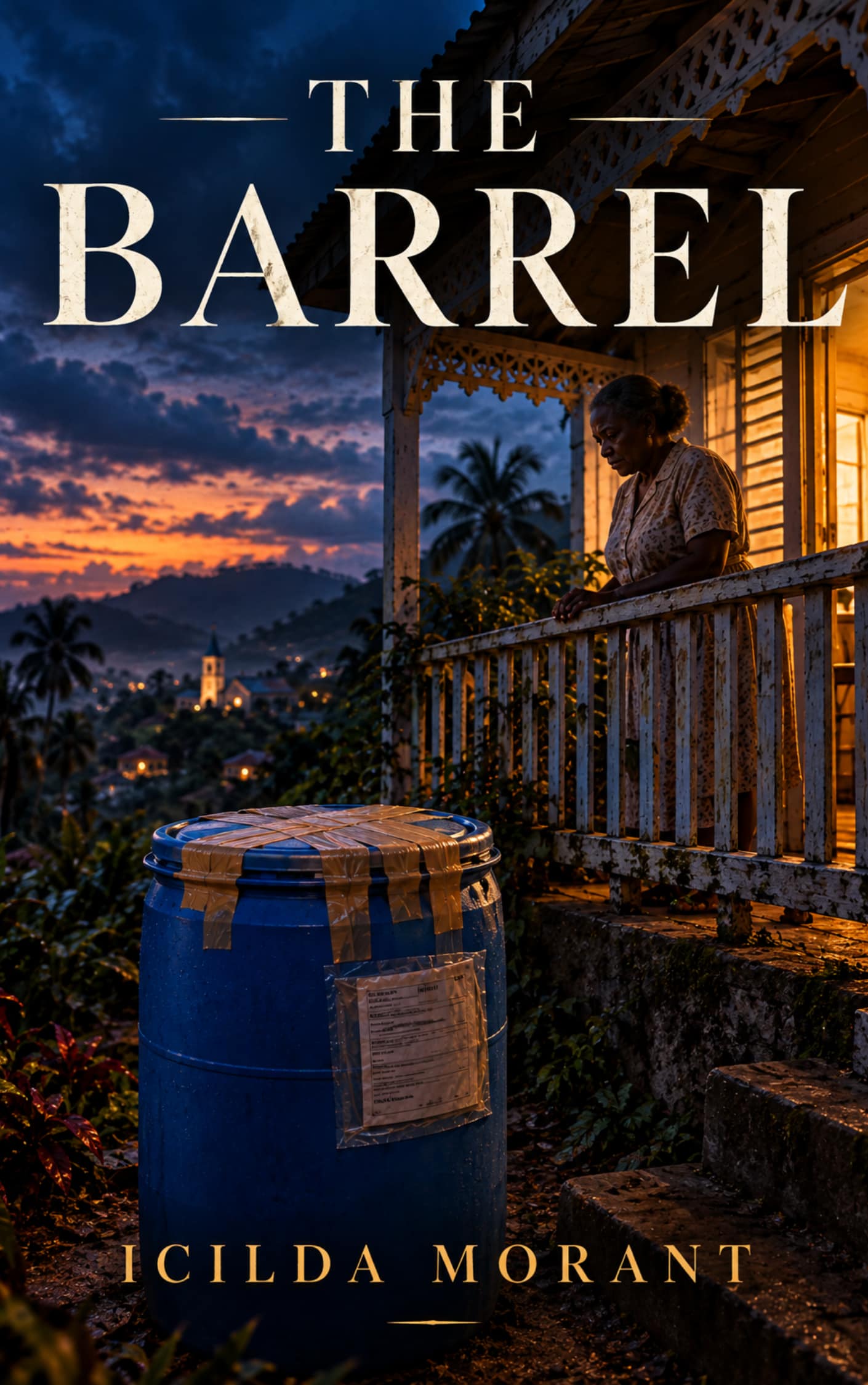
Books / Caribbean Gothic / Icilda Morant
A Jamaican ghost story novel
The Barrel
A novel by Icilda Morant
Every Christmas for twenty years, Desmond Morris shipped a barrel home to Jamaica. He died in March. In December, the barrel still comes.
Paperback and Kindle ebook. Available on Amazon.
Caribbean Gothic
195 pages, 6 x 9 in
From the first chapter
This morning it only lifted.
About the Book
It arrives at his sister Enid’s gate in the hills of St. Thomas, booked in his handwriting, paid for in cash at a Brooklyn depot weeks after his funeral.
The tape is sealed the way he always sealed it, four strips over four. But there is no rice inside, no school shoes, no bedsheets in their plastic. There are only four parcels, each with a name on it. A school tie. A child’s copybook. A ruler with a chip in its edge. A book of poems every Jamaican child once had to recite by heart.
The family laughs when Winston puts on the tie. Within days, no one can take it off him.
Enid is seventy-five. She is the one who stayed: who sewed her brother’s school uniforms, raised everyone’s children, and kept Nine Night alone when no one else remembered how. In 1963 she came first in the whole parish, and the letter that would have changed her life never arrived. Now, as the names on the barrel’s packing list are struck through one by one, she is the only one who understands what her dead brother is trying to do. And for the first time in sixty years, the family has to come to her.
Rooted in Jamaican duppy tradition and the hard choices of a family with money enough for only one child, The Barrel is a ghost story about what a family owes, who pays, and what it costs to finally stop waiting for next year. For the folklore the novel draws on, read why the Rolling Calf still haunts Caribbean horror fiction.
The Barrel sits on the adult side of the Maroon House Caribbean Gothic shelf. Younger readers, or anyone who wants the folklore with a lighter hand, can start with Miko Gray’s The Night My Shadow Moved.
For book clubs
The Barrel Book Club Kit
Everything your club needs in one place: twelve discussion questions for three meetings, who’s who, the setting, two recipes from the story, a playlist, and a note from Icilda Morant. Open any section below.
About the Book
For twenty Decembers, Enid Morris has listened for the truck on the bend below the church. Every year it brought a blue barrel from her brother Desmond in Brooklyn, packed with rice, soap and school shoes, taped four over four, with a packing list that always ended the same way: For Enid: see letter.
This December the barrel comes again, and Desmond has been dead since March. The handwriting is his, the tape is his, and the list names four members of the family and leaves Enid off. As Desmond’s daughter Danielle flies in from New York and the family gathers to open it, the barrel begins to give up what it holds, and every Morris must reckon with a debt that goes back to a schoolmaster on a bicycle in 1962.
The Barrel is a ghost story about inheritance, silence, and the girls who were told to wait their turn.
Who’s Who
- Enid Morris: Seventy-five, the keeper of the family house on the hill in St. Thomas, the old ways of mourning, and fifty-five years of her brother’s letters.
- Desmond Morris: Enid’s older brother, who won the family’s only high school place in 1962, left for Brooklyn in 1971, and sent a barrel home every Christmas for twenty years. He died in March on the A train.
- Danielle: Desmond’s daughter, a Brooklyn litigator who has not been back to Jamaica since she was eleven and who photographs anything she cannot explain.
- Winston: The youngest Morris sibling, seventy, big-voiced and easygoing, who cuts the tape on the barrel every Christmas Eve.
- Gloria: Winston’s wife, who brings escoveitch fish up the mountain in a Dutch pot.
- Andre: Winston and Gloria’s son, a clerk for a customs broker in Kingston who knows exactly which box on a manifest to read.
- Marcia: Andre’s wife, a nurse at the hospital in Kingston, who has carried the household as much as he has.
- Kemar: Their son, eighteen, a hard worker with his heart set on studying medicine at UWI.
- Shanice: Their daughter, seventeen, the best reader in the family since she was six, rarely seen without her chemistry book.
- Cyril and Iris Morris (Papa and Mama): Enid’s parents, seen in the chapters set in the 1960s. Papa cannot read and wears a key on a string around his neck.
- Mr. Clarke: The district schoolmaster, who tells ten-year-old Enid that she has the best head he has seen in twenty years of teaching.
- Lloyd Bailey: The shipping agent’s driver, who has brought every one of Desmond’s barrels up the hill.
- Miss Gertie: Keeper of the district shop and the postal agency at the back of it.
The Setting
The novel is set in an unnamed hill district in the parish of St. Thomas, in eastern Jamaica, high above the coast road that runs from Kingston to Morant Bay. The road climbs from a gas station on the coast through bamboo and breadfruit trees, past the Maxwells’ gate, the standpipe, and the broken wall where the Anglican school used to be, to a bend below the church that every family on the hill knows by the sound of a truck changing gears. The Morris house sits at the top with its veranda, its board walls, and a yard where the barrel stands at the foot of the steps, while the land falls away behind it into a valley and down to the river. At night the frogs in that valley are so loud that it sounds like a machine.
The present-day story runs from early December through New Year’s Day, across a family Nine Night, a Christmas Eve, and a watch-night service. Chapters marked “Then” return to the district between 1962 and 1971: the year of Independence, the Common Entrance results printed in the Daily Gleaner, the examination hall at Morant Bay, the Tuesday bus that brings the post, and the waving gallery at Palisadoes airport. Brooklyn appears through Desmond’s apartment on Rutland Road, his church on Eastern Parkway, and the shipping depot where he paid cash every November.
Discussion Questions
The questions are grouped for three meetings, so your club can read the book in thirds or discuss it all at once.
Meeting One: Chapters 1 to 8
- In Chapter One, the first barrel from a dead man arrives with a list of four names and no line for Enid, not even “see letter.” Enid knows it is impossible for the barrel to be there at all, yet what hurts is the omission, which makes her feel, “for the space of a breath, eleven years old and waiting at the gate for a letter.” Why do you think the author lets a missing line on a packing list land harder than the haunting itself? Have you ever been left off a list, a toast, or a family photograph, and how long did that small moment stay with you?
- Andre opens Chapter Three by noticing how things always go in his family: “A woman asked. A man decided. And everybody else stood in the yard and watched.” Minutes later, Winston passes over Shanice with “Mek the boy read it,” and Andre sees “his daughter’s face close like a door” and says nothing. What does this small scene in the yard tell you about how the family works long before the barrel’s contents are revealed? In your own family, who was chosen to read, speak, or lead, and who learned to stand back?
- The 1962 and 1963 chapters move between Mr. Clarke crouching to tell Enid “Next year is you,” Papa’s verdict through the board wall (“One. We can do one.”), and Mama’s careful advice on the night before the exam: “Whatever happen after, it nuh matter.” Later Papa says he collects the post “because mi tired of a pickney running down the hill every day to make herself shame in front of the whole district.” How did these chapters change the way you read Enid in the present day? Has anyone ever promised you that “next year” would be your turn, and what happened to that promise?
- Enid scatters rice in rings because “Duppy must count,” and after Winston’s death she covers every mirror and glass in the house, realizing that the custom was never to protect the dead: “It was so the living would not see who was standing behind them.” Danielle, watching the district arrive with Dutch pots and dominoes, understands that her father “had grown up inside a machine for grief,” and that nobody in Brooklyn had done any of it for him. What do the Nine Night traditions give this family that a forty-minute viewing in Brooklyn could not? Which mourning traditions has your family kept, and which have been lost along the way?
Meeting Two: Chapters 9 to 16
- In Chapter Nine, Gloria returns the faded blue cardigan and begs for forgiveness, and Enid tells her “Mi forgive yuh, Gloria” and means it. The pen goes back to the margin anyway. Enid also admits to herself that for ten years of Sundays “she had thought, at the time, that keeping quiet was the strong thing.” Why isn’t Enid’s forgiveness enough to end Gloria’s lines, and what does the book suggest is actually owed? Have you ever kept quiet about a wrong because silence felt like the dignified choice, and do you still see it that way?
- At school in Kingston, Mr. Ashworth brings the ruler down on Desmond’s knuckles and tells him that “we speak the Queen’s English. We do not speak the language of the yard.” Desmond learns “to talk like a radio,” and two years later, after whispering to Enid by candlelight that “It should be you,” he watches Papa burn her books: “He stood at his post, and watched the books burn, and said nothing at all.” How does “Casabianca” work in these chapters as more than a school recitation? Have you ever changed the way you speak, dress, or carry yourself in order to belong somewhere, and what did it cost you or the people you came from?
- In Chapter Twelve, Danielle reads fifty-five years of letters in order, matches them against her father’s bank statements, and finds the first barrel charge in December 2006, the year her loans were paid off. “He had never sent for her. He had sent her towels.” She writes “He chose me” on a napkin, and Enid answers that she never blamed him for that: “What mi blame him for is the lie.” Why does Enid separate the choice from the lie, and do you agree with her? Have you ever discovered that something you were given came at someone else’s expense, and how did you wish you had learned it?
- At the dinner table in Chapter Sixteen, Andre repeats his grandfather’s words almost exactly (“This is how a family rise… Yuh put everything on one”) without knowing he is doing it, and Enid’s hand closes on the arm of her chair. Kemar tries to speak and is told “Mi decide,” and Shanice folds her napkin and asks, “May I be excused?” Two chapters earlier, Enid admits that for the first time in her life “she was the one holding the list,” and that “she was not ready to let them stop.” Who holds power in these scenes, and how is each person using or refusing it? What sayings or beliefs did you inherit from your family before you were old enough to question them?
Spoiler warning: these questions discuss the ending. Please finish the book before reading further.
Meeting Three: Chapters 17 to 24 and the Coda
- On Christmas Eve morning, Andre takes his decision back in a rush, and Shanice refuses it: “Mi not a ransom. Mi not something yuh throw at a duppy so it leave yuh alone.” Hours later at Papa Cyril’s grave, Andre offers Enid the house, and she asks him, “Yuh think mi want a house?” before telling him that in sixty-three years “not one of yuh ever ask me what mi want.” Why do both offers fail, even though each one gives the right person something real? Think of a time someone tried to make things right with you out of fear or guilt rather than understanding. How did you know the difference?
- Chapter Nineteen finally shows Desmond at fifteen, kneeling at Papa’s trunk with a penknife and the Ministry letter. He asks himself “And then what?” and builds a reasonable case for silence, then seals the envelope four over four so tight that “nobody would be able to say he had done it halfway.” The chapter ends with the tape on every barrel: “He told her it was so nothing would come loose. That was true. That was exactly what it was for.” Did seeing the moment from his side change how you judge him, or did it make the silence harder to forgive? Have you ever kept a secret that you told yourself was for someone else’s protection, and whose protection was it really?
- Behind the house in Chapter Twenty, Enid tells her brother’s ghost, “Yuh don’t get to make it right with my hands.” The next night, Shanice sits at the kitchen table and offers to give up her place, saying, “Mi strong. Mi will manage. Mi always manage,” and Enid hears her own life in those words. She tells Shanice the barrel was never about a fight over a place: “Is the giving way. Is a girl standing back so a boy can go first, and everybody calling it strong.” Why is it Shanice’s sacrifice, rather than any argument from Andre or Danielle, that changes Enid’s mind? Where have you seen the women in your life praised for being strong when what they needed was for someone to ask them what they wanted?
- The ending turns on small, plain acts: Andre asking his daughter “What do yuh want?” and then waiting, Enid insisting “Yuh nuh do it yet” because “this family have enough of promises,” the receipt stamped at 11:56, Danielle forcing out “You can go now, Daddy” in her own cracked voice, and a new last line on the packing list, “FOR ENID: SEE LETTER.” In the Coda, Enid asks Shanice “Read it to me,” and when Andre suggests waiting, she answers, “Not next year. This one.” What do you make of the barrel standing untaped under the gutter, full of rain? What is one “next year” in your own life that you could decide, tonight, to make this one?
From the Kitchen
The Drink: White Rum Punch (with a Non-alcoholic Option)
White rum runs all through this book: the Wray & Nephew bottle Danielle cannot bring herself to drink at her father’s kitchen table on Rutland Road (Chapter Two), Miss Gertie’s bottle of white rum carried up the hill when Desmond passes Common Entrance (Chapter Four), and the white rum poured over nine nights of dominoes and hymns (Chapter Eight). This punch follows the old Jamaican rule of one of sour, two of sweet, three of strong, and four of weak.
Makes about 8 servings
- 1 cup sugar and 1 cup water (for the simple syrup)
- 1/2 cup fresh lime juice (about 4 to 5 limes)
- 1 1/2 cups Wray & Nephew White Overproof Rum, or a standard white rum for a lighter punch
- 1 cup pineapple juice
- 1 cup cold water
- 3 to 4 dashes Angostura bitters
- Freshly grated nutmeg
- Ice and lime wheels for serving
- Make the syrup: stir the sugar and water together in a small saucepan over medium heat until the sugar dissolves, then let it cool completely. You will use 1 cup of it.
- In a large pitcher, stir together the lime juice and 1 cup of the cooled syrup.
- Add the rum, pineapple juice, cold water and bitters, and stir well.
- Chill for at least 1 hour.
- Pour over ice, grate a little nutmeg on top, and garnish with a lime wheel.
Non-alcoholic option: Replace the rum with 1 1/2 cups of chilled ginger beer, or with fresh coconut water like the coconuts Danielle sees being sold off the back of a pickup on the road out of Kingston (Chapter Two). Add the ginger beer just before serving so it keeps its fizz.
Safety note: Wray & Nephew White Overproof is 63 percent alcohol by volume, far stronger than ordinary rum. Pour small servings, label the pitcher clearly, keep a non-alcoholic pitcher alongside it, and keep overproof rum away from open flames and candles.
The Dish: Gloria’s Escoveitch Fish
In Chapter Three, Gloria makes escoveitch fish for the Sunday the family opens the barrel and carries it up the mountain on her lap “in a Dutch pot wrapped in a towel.” Escoveitch is fried fish under a hot, peppery vinegar pickle, and it is one of the few dishes that tastes even better the next day, which makes it a good choice for a book club host.
Serves 4
For the fish:
- 2 pounds whole red snapper (2 small fish, scaled and cleaned), or 4 snapper fillets
- 2 limes, halved
- 1 1/2 teaspoons salt
- 1 teaspoon freshly ground black pepper
- 1/2 cup all-purpose flour (optional, for a crisper crust)
- About 1 cup vegetable oil, for frying
For the pickle:
- 1 1/2 cups white vinegar
- 10 pimento (allspice) berries
- 1 teaspoon sugar
- 1/2 teaspoon salt
- 1 medium onion, thinly sliced
- 1 medium carrot, cut into thin matchsticks
- 1/2 red bell pepper, thinly sliced
- 1 Scotch bonnet pepper, thinly sliced (remove the seeds for less heat)
- 1 tablespoon of the oil used for frying
- Rub the fish all over with the cut limes, rinse it, and pat it completely dry with paper towels. If using whole fish, cut two or three shallow slashes into each side.
- Season the fish inside and out with the salt and black pepper. If using flour, dredge the fish lightly and shake off the excess.
- Heat the oil in a heavy skillet over medium-high heat to about 350°F. Fry whole fish for 5 to 7 minutes per side, or fillets for 3 to 4 minutes per side, until golden and crisp and the flesh flakes easily. Drain on a rack or on paper towels.
- Make the pickle: in a small saucepan, combine the vinegar, pimento berries, sugar and salt, and bring to a simmer. Add the onion, carrot, bell pepper and Scotch bonnet, and simmer for 2 to 3 minutes, until the onion just softens. Stir in 1 tablespoon of the frying oil.
- Lay the fish in a deep serving dish and pour the hot pickle and vegetables over it.
- Serve warm, or let it stand at room temperature for up to 1 hour so the fish absorbs the pickle. For the best flavor, cover and refrigerate it overnight and serve it cold or at room temperature the next day, with hard dough bread on the side.
Safety notes: Wear gloves when cutting the Scotch bonnet, and keep your hands away from your eyes until you have washed them well. Dry the fish thoroughly before it goes into the pan, because water makes hot oil spatter, and never leave hot oil unattended. Refrigerate leftovers within 2 hours and eat them within 3 days.
The Playlist
| # | Artist | Song | Why it fits |
|---|---|---|---|
| 1 | Bob Marley & The Wailers | Duppy Conqueror | A Jamaican song about standing up to a duppy, for a book about a family that has to face one. |
| 2 | Toots and the Maytals | Pressure Drop | A song about what is coming due, for a family whose debt finally arrives by truck. |
| 3 | Lord Kitchener | London Is the Place for Me | The Windrush-era hope that sends Mr. Clarke to Birmingham with the promise of work on the buses. |
| 4 | Jimmy Cliff | Many Rivers to Cross | Enid waiting at the gate, at the counter, at the airport rail, for a crossing that never comes. |
| 5 | Bob Andy | I’ve Got to Go Back Home | Desmond’s barrels were the way he sent himself home every December without ever going. |
| 6 | The Melodians | Rivers of Babylon | A psalm of exile sung in Jamaica, for a family scattered between St. Thomas and Brooklyn. |
| 7 | Ken Boothe | Everything I Own | A song about offering everything you own to undo a loss, which is Desmond’s impossible project in barrel after barrel. |
| 8 | Nina Simone | Four Women | Black women carrying the weight others hand them, from Enid’s generation to Shanice’s. |
| 9 | Mahalia Jackson | Precious Lord, Take My Hand | For the hymns that carry the Nine Night through to dawn on the hill. |
| 10 | Sam Cooke | A Change Is Gonna Come | For the first morning of the new year, and an old woman filling out passport forms. |
A Note from Icilda Morant
Dear readers,
When I was small, there was a blue drum at the corner of almost every yard in our district. Some held water and some held yam heads. One, at a neighbor’s house, held nothing but rain, and I used to stand on my toes to look into it and see the sky and my own face looking back. I did not know then that each of those drums had first come up the hill full of someone’s love and someone’s guilt, and that the two were often packed in the same layer.
This book began with a question I could not put down: what do we owe the people who stayed behind? I kept thinking about the women who sewed the uniforms and read other people’s letters aloud, who kept Nine Night when nobody else remembered the hymns, and who were told so gently, and for so long, that next year would be theirs. Enid is not any one of them. She is made from all of them, and from the silence they kept.
I hope your club argues about Desmond. I still do. And I hope that someone at your table asks the person beside them what they want, and then waits for the answer.
Thank you for opening this barrel together, for giving these pages your evenings, and for reading all the way to the last line.
With gratitude,
Icilda Morant
Frequently asked questions
About The Barrel
Is there a book club guide for The Barrel?
Yes. The free book club kit on this page has twelve discussion questions grouped for three meetings, a who’s who, the setting, recipes for white rum punch (with a non-alcoholic option) and Gloria’s escoveitch fish from the story, a ten-song playlist, and a note from Icilda Morant.
Where is The Barrel set?
In an unnamed hill district in the parish of St. Thomas, in eastern Jamaica, above the coast road from Kingston to Morant Bay. The present-day story runs from early December to New Year’s Day, and chapters marked “Then” return to the district between 1962 and 1971. Brooklyn appears through Desmond’s apartment on Rutland Road.
Who wrote The Barrel?
Icilda Morant, who grew up in St. Thomas, Jamaica, and writes horror for adults. The Barrel is her first novel. Read more about Icilda Morant.
About the author
Icilda Morant
Icilda Morant grew up in St. Thomas, Jamaica, in a district where children were warned never to answer if they heard their name called after dark. She writes horror for adults about bloodlines, broken promises, and the price of staying alive. The Barrel is her first novel.
As an Amazon Associate, Maroon House Press earns from qualifying purchases.