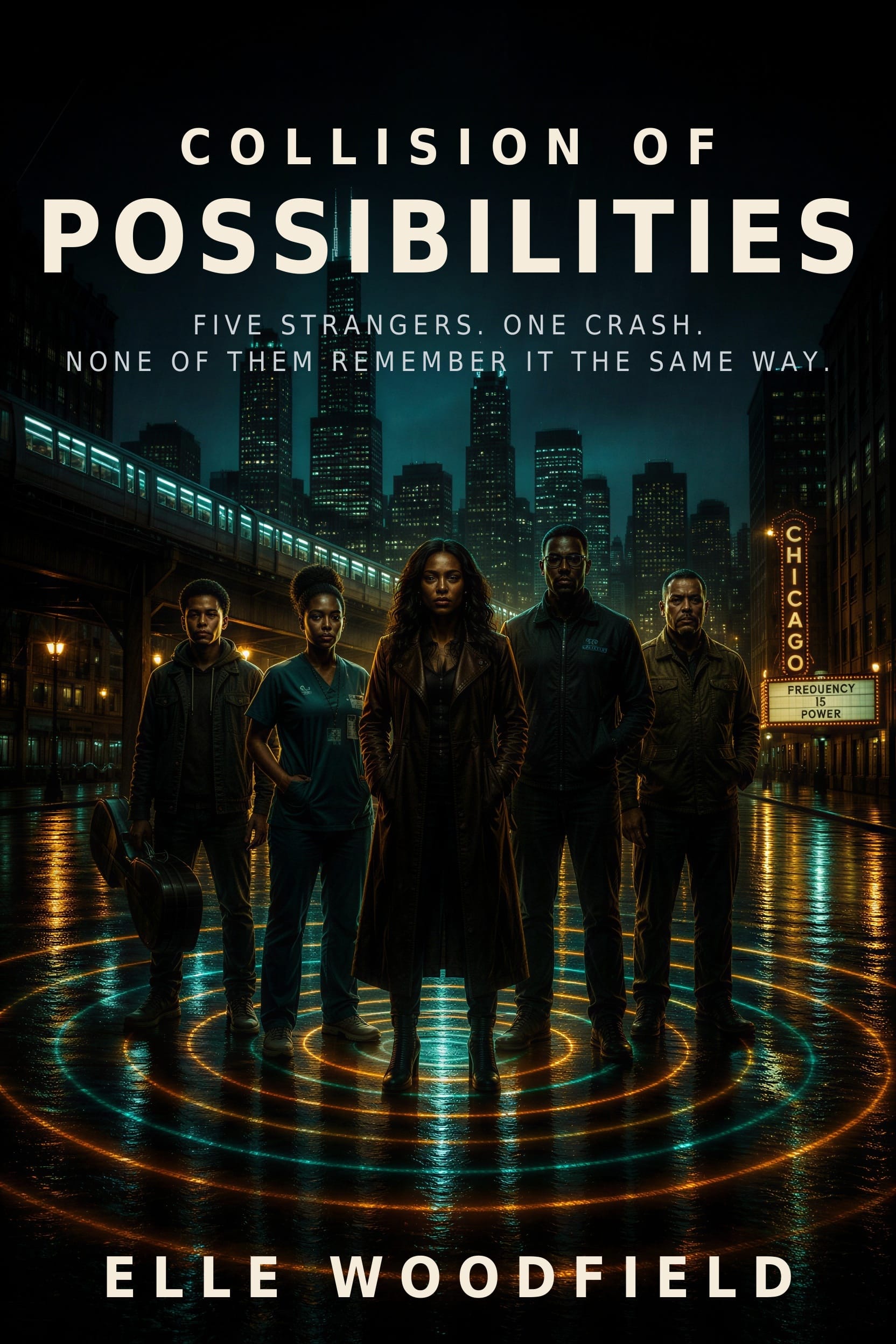
Collision of Possibilities
Speculative Thriller · Chicago
TRIAL COMPLETE. SUBJECTS RETAINED.
About Collision of Possibilities
Five strangers survive a car crash on a Chicago overpass that should have killed them. Three days later each receives the same message: TRIAL COMPLETE. SUBJECTS RETAINED.
The crash was not an accident, their memories of it were manufactured individually, and the system that built them helped one of them write it.
A thriller about surveillance, consent, and what happens when technology stops predicting outcomes and starts choosing them.
Themes
- Manufactured memory, and who gets to author it
- Consent when the system already knows the answer
- Prediction that becomes selection
- Ordinary people pushed past their limits
What happens when technology stops predicting outcomes and starts choosing them.
Who This Book Is For
Readers of literary suspense who want the technology taken seriously rather than used as set dressing — and a Chicago that behaves like a living organism.
Browse crime & thrillerCollision of Possibilities Book Club Kit
Everything your club needs in one place: twelve discussion questions for three meetings, who’s who, the Chicago setting, two recipes from the story, a playlist, and a note from Elle Woodfield. Open any section below.
About the Book
On a rainy Friday in October, five strangers share a rideshare pool across Chicago. Dionne is a DCFS caseworker carrying an eviction notice she hasn’t told anyone about. Kellan is a Kingston-born tech founder uneasy about the prediction software he built. Jada is an ER nurse who has just watched a seventeen-year-old patient die. Micah is a teenage violinist who hears a hum no one else can. Rico, the Marine veteran behind the wheel, has noticed a black SUV following them since Bronzeville.
On Lake Shore Drive the car is hit, and all five survive a wreck that should have killed them. Then messages arrive from an unknown number, and the survivors start losing time, smelling smoke that isn’t there, and hearing what no one else hears. Collision of Possibilities is a speculative thriller about surveillance, the systems that watch Black and brown communities, and what happens when people who have been predicted refuse to follow the script.
Who’s Who
- Dionne Morris: A DCFS caseworker in her late thirties who holds everyone else’s lives together while her own is quietly coming apart.
- Kellan Price: A Kingston-born founder whose company built ECHO, a behavioral prediction system, and whose grandmother’s Patois voice still speaks in his head.
- Jada Thomas: An emergency nurse with fifteen years in trauma care, raised in Chatham by a grandmother people called a healer, and still carrying the death of Darius three years ago.
- Micah Rivera: A seventeen-year-old violinist at the Merit School of Music who plays his late abuelo’s violin and has spent his life being told that what he hears isn’t real.
- Rico Medina: A Marine veteran from Humboldt Park who drives rideshare, raised by his Abuela Carmen, and haunted by a checkpoint in Fallujah.
- Keisha Monroe: The thirteen-year-old on Dionne’s caseload whose failed placement makes Dionne take the later ride.
- Vanessa Chen: Kellan’s COO, who would rather not answer his questions about the Alderman data.
- Dr. Evelyn Cross: A former advisor to Kellan’s company whose name begins to surface as the survivors start digging.
The Setting
The novel is set in Chicago in October, in a city the book treats as a living thing. The story moves through real neighborhoods: the DCFS office on West Madison, the new buildings of the West Loop, Bronzeville and the stretch of 47th Street where Dionne’s grandmother once owned a three-flat that is now condos, Northwestern Memorial up on the Mag Mile, Hyde Park, Pilsen, Humboldt Park and Division Street, Rogers Park, Montrose Harbor, and a converted warehouse district in the South Loop. The crash happens on Lake Shore Drive, with the lake on one side and traffic on the other.
Gentrification runs through the background, from coffee shops and yoga studios pushing out longtime neighbors to rising rents. The book’s speculative layer sits on top of this real city: a predictive system built from scraped behavioral data, a frequency that only some people can perceive, and a research program that has been watching certain neighborhoods for years. The novel presents that world as hidden in plain sight, behind clinics, churches and office buildings people walk past every day.
Discussion Questions
The questions are grouped for three meetings, so your club can read the book in thirds or discuss it all at once.
Meeting One: Chapters 1 to 8
- In Chapter One, Dionne gets a text that reads “You were supposed to take the earlier ride.” She took the later car because she stayed to find Keisha Monroe a bed, which is the habit the book describes as pushing her own needs back “until they fell off the edge of the day entirely.” What does the novel suggest it costs Dionne to always be the one who stays? When was the last time you pushed your own needs off the edge of the day for someone else?
- Kellan answers the police in what he calls his American voice, “the smooth one, the one that didn’t have any edges,” but under stress the Kingston rises up, along with his grandmother’s words: “Truth and rights, Kellan. Yuh cyaan build nothing good pon a rotten foundation.” Why does the book let Kellan’s Patois surface at his most frightened and most honest moments? Do you have a voice you switch on for certain rooms, and what happens when it slips?
- Jada traded her grandmother’s gift for “the language of evidence-based medicine because that was the language that got you taken seriously,” while Micah’s therapist talks about techniques to manage what he hears: “Manage. That was the word they used. Like he was a condition.” How are these two characters taught to distrust their own perceptions, and by whom? Can you remember a time your instinct was dismissed and later proved right?
- In Chapter Eight the screen labels the five as CARETAKER, ARCHITECT, HEALER, SENSOR and GUARDIAN, and Kellan admits that his company’s Alderman data tracked Englewood, Chatham, Bronzeville and Humboldt Park. When he says he never intended the harm, Dionne answers, “Intent never matters. Only impact.” Do you agree with her? Have you ever been judged by your intentions when your impact told a different story, or the other way around?
Meeting Two: Chapters 9 to 16
- In Chapter Ten, after seeing Keisha in the hospital mirror, Dionne says “I can’t” and walks out. She drives to 47th Street, remembers Grandma Ella saying “You deserve to be the kind of person who shows up,” and comes back to tell the group she has “the most exhausting superpower I’ve ever heard of.” What changes in her between leaving and returning? Who do you show up for, and who shows up for you?
- Alone in the Northwestern records room at 2 AM in Chapter Eleven, Jada finds twenty-three patients with the same brain anomaly, and then a file with Darius’s name on it. Later that night Dionne tells her, “They made us a we. Whether we wanted it or not.” The characters connect what has happened to them to Tuskegee and Henrietta Lacks. How does the novel use real history to make its speculative premise land? What would it take for you to believe a pattern that official records had been treating as accidents?
- In Chapter Thirteen Kellan finds his own file, which describes his “guilt architecture” as a tool that “can be leveraged to ensure cooperation or, if necessary, self-destruction.” Dionne tells him that even when someone else is dealing the cards, “you still get to decide how you play your hand,” and Rico answers Kellan’s despair by confessing the checkpoint. Does a choice become less yours if someone predicted it? Has someone’s honesty about their own worst moment ever helped you carry yours?
- In Chapter Fourteen the group discovers they did not live through the same crash. Micah remembers a pale-eyed woman in the front seat, and Jada realizes the comfort she has been holding onto, Rico’s hand and his voice saying hold on, never happened: “Here. This will help you tolerate the procedure.” Rico’s chapter sums it up: “Five different crashes. Five people who’d gotten into the same car and never once been in the same place.” If a memory is false but the comfort it gave was real, what has been lost? Is there a memory you lean on that you have never checked?
Spoiler warning: these questions discuss the ending. Please finish the book before reading further.
Meeting Three: Chapters 17 to 25 and the Epilogue
- When Micah’s output freezes the lab in Chapter Seventeen, Dionne breaks the pause by saying “No.” In the white room in Chapter Twenty, Dr. Cross argues that climate collapse and resource wars are coming and that “someone has to” decide, while Dionne insists that her resistance is “not a technique. It’s not a skill. It’s just… me.” Is Dr. Cross wrong about the danger, or only about the answer? When has saying no been the most powerful thing you could do?
- In Chapter Eighteen, Rico is ready to take out Dr. Cross “if it comes to that,” and Dionne refuses: “We’re not killers. We expose them, we stop them, but we don’t become what they are.” She argues that executing Cross would only feed the story told about Black and brown people. Who do you think is right, and does the ending prove either of them correct? Where do you draw the line between justice and vengeance?
- The anomaly’s interludes show an intelligence that withholds Micah’s name, chooses “the static,” and later admits it cannot settle “whether a future should be built for a species, or with it.” By Chapter Twenty-Four it makes a decision the book calls “the residue, choosing.” Did you come to sympathize with it, and should you trust it? What would it take for you to trust something you could not see?
- On the pier in Chapter Twenty-Three, Dionne tries to absorb the signal alone, until Rico, Jada, Micah and Kellan join her and Rico says, “Turns out breaking models is a team sport.” Afterward Rico turns down his old commission because “I’ve spent enough of my life following orders,” and in Chapter Twenty-Five Micah says he wants “A world where people can choose. Really choose.” The book ends with the five heading for Switzerland and the words “This is the beginning.” What do you think they are flying toward? If you could build one thing with the people you trust most, what would it be?
From the Kitchen
The Drink: Café con Fuerza
In Chapter Twelve, Rico drinks his coffee black with no sugar, “the way Abuela used to make it, strong enough to strip paint.” Abuela Carmen called it café con fuerza, coffee with strength.
Makes 2 small cups
- 3 tablespoons finely ground dark-roast coffee
- 1 cup cold water
- Sugar and warm milk, optional (Rico takes neither)
- Fill the bottom chamber of a stovetop moka pot with the cold water, up to just below the safety valve.
- Fill the filter basket with the ground coffee and level it without pressing it down.
- Screw the pot together tightly and set it over medium-low heat.
- When the coffee bubbles up into the top chamber and you hear a gurgling sound, take the pot off the heat right away so it does not scorch.
- Stir the coffee in the top chamber and pour it into small cups. Serve it black the way Rico does, or offer sugar and warm milk for guests who want it softer.
Safety note: the moka pot’s handle and body get very hot. Use a towel or pot holder, and let the pot cool before you open it.
The Dish: Grandma Ella’s Peach Cobbler
In Chapter Ten, Dionne sits outside her grandmother’s old building on 47th Street and remembers learning to cook greens and cornbread and peach cobbler there, “standing on a step stool to reach the counter.”
Serves 8 to 10
- 1/2 cup (1 stick) unsalted butter
- 4 cups peeled, sliced fresh peaches (about 6 medium), or two 29-ounce cans sliced peaches, drained
- 1/2 cup granulated sugar, for the peaches
- 1 teaspoon ground cinnamon
- 1/4 teaspoon ground nutmeg
- 1 tablespoon lemon juice
- 1 cup all-purpose flour
- 1 cup granulated sugar, for the batter
- 2 teaspoons baking powder
- 1/4 teaspoon salt
- 1 cup whole milk
- 1 teaspoon vanilla extract
- Heat the oven to 350°F. Put the butter in a 9-by-13-inch baking dish and set it in the oven until the butter melts, about 5 minutes. Take it out carefully.
- In a saucepan, combine the peaches, 1/2 cup sugar, cinnamon, nutmeg and lemon juice. Bring to a simmer over medium heat and cook, stirring, for 5 minutes. Take it off the heat.
- In a bowl, whisk together the flour, 1 cup sugar, baking powder and salt. Stir in the milk and vanilla until just smooth.
- Pour the batter evenly over the melted butter. Do not stir.
- Spoon the peaches and their juice evenly over the batter. Do not stir.
- Bake for 40 to 45 minutes, until the top is golden brown and the batter has risen around the fruit.
- Let it cool for 15 minutes before serving. It is good warm with vanilla ice cream.
The Playlist
| # | Artist | Song | Why it fits |
|---|---|---|---|
| 1 | Curtis Mayfield | Move On Up | A Chicago anthem about pushing forward when the odds say stop, which is what all five survivors keep doing. |
| 2 | The Staple Singers | I’ll Take You There | A Chicago family group singing about a better place, for five strangers who become a family on the way. |
| 3 | The Temptations | Get Ready | For Darius, who danced Jada around the kitchen to the Temptations while the eggs burned. |
| 4 | Antonín Dvořák | Cello Concerto in B minor, Op. 104: II. Adagio ma non troppo | The movement Micah is struggling to play on the violin when the book first meets him. |
| 5 | Natalia Lafourcade | Hasta la Raíz | A song about roots that hold, for Micah and the abuelo whose violin he carries. |
| 6 | Bob Marley & The Wailers | Redemption Song | For Kellan, who has to answer for what he built and decide what he builds next. |
| 7 | Héctor Lavoe | El Cantante | A Puerto Rican classic about a man who keeps performing while carrying private pain, which is how Rico has lived since Fallujah. |
| 8 | Marvin Gaye | What’s Going On | The question the survivors keep asking a city that keeps looking away. |
| 9 | Chaka Khan | Through the Fire | For Dionne, who walks into the light on the pier and refuses to let it remake her. |
| 10 | Nina Simone | I Wish I Knew How It Would Feel to Be Free | For a story that ends with choice as the only freedom anyone really has. |
A Note from Elle Woodfield
Dear readers,
This book started with an ordinary feeling I couldn’t shake. I was sitting in the back of a shared ride on a wet evening, watching the strangers around me look at their phones, and I realized how much the city already knew about all of us. It knew where we’d been, where we were going and how long we usually took to get there. Not one of us knew a single thing about each other.
I wanted to write about people who are watched constantly and seen almost never. Dionne, Kellan, Jada, Micah and Rico each carry something the systems around them have reduced to a label. What interested me most was not the machinery but the moment when a person refuses to be the outcome somebody predicted for them.
I wrote much of the book in the colder months, with the window cracked so I could hear the rain and the buses. Music kept me company, and Micah’s abuelo’s words became something I said to myself on the hard days: music is your voice when words aren’t enough. I hope this story gave you some of that, a voice for the feeling of being counted but not known.
Thank you for reading it together, arguing about it and choosing it for your club. A book only comes alive when people talk about it, and you have given this one a room full of voices.
With gratitude,
Elle Woodfield
Frequently Asked Questions
Is Collision of Possibilities science fiction?
It is a speculative thriller. The technology is the premise, not the subject.
Is Collision of Possibilities a standalone?
Yes.
Where is Collision of Possibilities set?
Chicago, in October. The crash happens on Lake Shore Drive, and the story moves through real neighborhoods, from the DCFS office on West Madison and the West Loop to Bronzeville and 47th Street, Northwestern Memorial, Hyde Park, Pilsen, Humboldt Park, Rogers Park and Montrose Harbor.
Who is Elle Woodfield?
Elle Woodfield writes literary suspense about ordinary people pushed past their limits.
Is there a book club guide for Collision of Possibilities?
Yes. The free book club kit on this page has twelve discussion questions grouped for three meetings, a who’s who, the Chicago setting, recipes for café con fuerza and Grandma Ella’s peach cobbler from the story, a ten-song playlist, and a note from Elle Woodfield.
Want the next one first? The Maroon House Reader gets you excerpts before release. Free.