Caribbean & Diaspora Storytelling
Literary Fiction · Historical Fiction · Askenish, Hanover, Jamaica
Provision Ground
The Land They Could Not Prove · Lorna Phillips
For everyone living on ground they cannot prove.
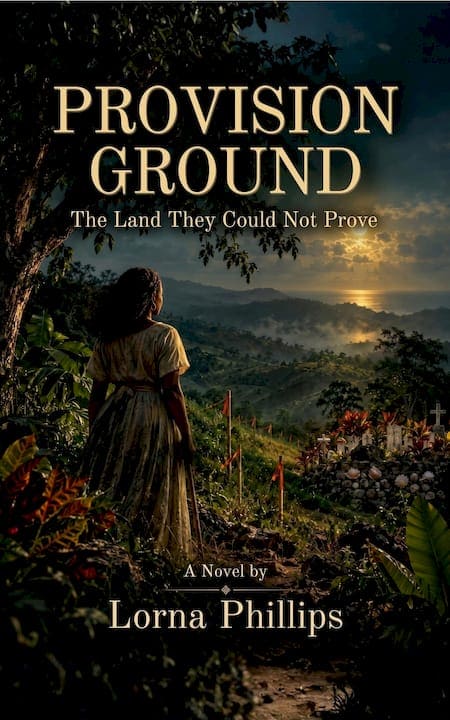
Nine survey stakes run through Merline’s yam hills in Askenish, Hanover. The land has been her family’s for a hundred years, and none of it is on paper.
978-1-971058-26-9 (ebook)
About the book
The stakes were new pine, and there were nine of them.
Merline counts them from the taxi, then again at the gate with her shoes in her hand, then a third time standing in the yard, as though the number were the thing that mattered. Orange tape at the head of each one. They begin at the guango tree on the corner of her mother’s yard, run down through the yam hills in a line straighter than anything else on that hillside, and stop where the ground gives way to the gully.
Somebody walked that line with an instrument. Somebody stood in her mother’s yam, sighted through a lens, wrote a figure in a book, and drove back to Lucea for their dinner.
She has been in the country a little over two weeks. She buried her mother on the ninth day.
What follows is the thing every Jamaican family with land and no title eventually finds out: that living somewhere for a hundred years and being able to prove it are two entirely different propositions, and only one of them is admissible.
…containing by estimation Four hundred and nine acres be the same more or less…Conveyance of Askenish Estate, 1894
Themes
- Family land, and the difference between holding ground and proving it
- What a document is for, and who it was built to serve
- A Scottish name on a Jamaican hillside, and the line that put it there
- Two hundred years of paperwork, read by the people it was written about
The record, and the other record
The novel moves between the hillside now and the paper trail behind it — a declaration of 1801, a survey and its endorsement, a Chief Clerk’s report, conveyances, a certificate of title, an agreement for sale. All of them invented, and all written to the pattern of real ones.
It also goes to Ross-shire, where a boy of eighteen left for the coach at Dingwall in September 1790 because the tack had gone and there was nothing for him. His sister waved twice on the road. She asked in every letter for eighteen years when he was coming home, and stopped asking in 1808.
What she never read, because the attorney saw no reason to write it out for a bereaved woman in Scotland, was the clause naming the children of a woman belonging to the estate.
That is the whole architecture of the book: two families, one surname, and a document that says everything by leaving one sentence out. How Scottish names reached Jamaica, and why so many Scots were there to leave them.
A note on Askenish
Askenish is a real district in the parish of Hanover, in the hills inland of Lucea, and the people there grow yam.
That is the only true thing in the book. There was never an Askenish Estate. Every family on that track is invented, every document is invented, and no land there is in dispute on account of anything written in these pages.
Who this book is for
Readers of Diana McCaulay’s A House for Miss Pauline, winner of the 2026 RSL Ondaatje Prize, who want another Jamaican novel about land, inheritance and the long afterlife of slavery.
Readers of Jamaican literary fiction about land, inheritance and the archive. If you have ever been told your family has been somewhere for generations and then been asked to produce the deed, this novel is about that gap. It sits on our historical fiction shelf beside Swift River.
Frequently asked questions
Is Askenish a real place?
Yes — a district in Hanover, inland of Lucea. Askenish Estate, the families and every document in the novel are invented.
Is it a standalone?
Yes. It requires nothing read beforehand.
What books are like Provision Ground?
Diana McCaulay’s A House for Miss Pauline, winner of the 2026 RSL Ondaatje Prize, is the closest companion: a Jamaican novel about inheritance and what slavery left behind on the land. For more, see our list of Jamaican novels worth reading first.
What is provision ground?
Historically, the plot enslaved people were allotted to grow their own food on. After emancipation much of that ground became family land — held, worked and inherited without title.
How long is it?
383 pages. ISBN 978-1-971058-25-2 paperback, 978-1-971058-26-9 ebook.
What else has Lorna Phillips written?
Swift River: The Water That Remembers, set in Portland Parish. Both novels are on the historical fiction shelf.
Tracing a Jamaican line of your own? Read the Names is free, and how to trace Jamaican ancestry walks the five archives in order. The short story Family Land takes up the same question in miniature.
The Maroon House Reader
First look at every new title, straight from the publisher’s desk.
Excerpts before release, notes on what we’re acquiring, and the occasional dispatch from Jamaica. Sent when there’s something worth sending.
One email at a time. Unsubscribe whenever you like.