
The Best Migration Novels to Read Right Now
Start with these seven: What Strange Paradise by Omar El Akkad, Exit West by Mohsin Hamid, The Refugees by Viet Thanh Nguyen, The Art of Losing by Alice Zeniter, The Year of the Runaways by Sunjeev Sahota, Amnesty by Aravind Adiga, and The World and All That It Holds by Aleksandar Hemon. Between them, these seven books cover almost every migration story worth knowing: forced displacement, undocumented labor, colonial exile, and the strange purgatory of waiting for papers that may never come. Maroon House Press curates fiction from the Caribbean and Black diaspora with this same conviction: migration stories land hardest when they’re told from inside the experience, not observed from outside it. Nonprofit resettlement organizations like Global Refuge build reading lists on the same principle.
Here’s the quick-pick shortlist to grab before you read further:
- Exit West by Mohsin Hamid — a couple flees war through literal magic doors, and the novel becomes a meditation on what refugee life does to intimacy.
- What Strange Paradise by Omar El Akkad — a drowned boat, a surviving child, and a Mediterranean island community forced to reckon with what they owe him.
- The Refugees by Viet Thanh Nguyen — short stories following Vietnamese refugees in California, told with a wit that undercuts easy sentiment.
- The Art of Losing by Alice Zeniter — three generations of an Algerian family in France, tracing what colonial war does across a bloodline.
- The Year of the Runaways by Sunjeev Sahota — undocumented Indian laborers in Sheffield, England, told with unflinching detail about debt and survival.
- Amnesty by Aravind Adiga — a Sri Lankan cleaner in Sydney, Australia, decides whether reporting a murder is worth his own deportation.
- The World and All That It Holds by Aleksandar Hemon — a Sarajevo pharmacist’s odyssey across empires and wars, propelled by love and displacement.
Themed groupings, selection advice, and further reading follow below.
Key Takeaways
Migration novels work best when a reader matches viewpoint, migration context, and content sensitivity to the specific book before starting it.
| Point | Details |
|---|---|
| Start with the shortlist | Begin with Exit West, What Strange Paradise, and The Refugees for a fast survey of three distinct migration experiences. |
| Match voice to intent | Choose first-person novels like Amnesty for intimacy, multi-voiced ones like The Refugees for range. |
| Check content notes first | Titles like What Strange Paradise and The Year of the Runaways depict drowning, detention, or exploitative labor directly. |
| Pair fiction with memoir | Autofiction like Infinite Country adds testimonial texture that pure invention can’t replicate. |
| Trace your own line | Reading migration fiction often sends people toward their own family history, where the same gaps and silences show up in the record. |
| Explore Caribbean-specific migration fiction | Maroon House Press’s Caribbean fiction catalog centers colonial-era and diaspora displacement from inside the communities that lived it. |
Table of Contents
- Why Migration Novels Matter Right Now
- Migration Novels Grouped by Theme
- How to Choose the Right Migration Novel for You
- Further Reading: Memoirs, Essays, and YA Migration Books
- A Publisher’s Perspective on Migration and Diaspora Fiction
- What Actually Makes a Migration Novel Worth Your Time
- Find Your Next Migration Story With Maroon House Press
- Frequently Asked Questions
- Sources
Why Migration Novels Matter Right Now
Migration novels do something the nightly news can’t: they put you inside one person’s skull during the worst decision of their life. A headline tells you 3,000 people crossed a border. A novel makes you feel the specific ache of a mother deciding whether to leave her mother behind. That’s the whole case for fiction over reportage, and it’s why Global Refuge built an entire curated reading list around books that restore individual agency to people the news tends to flatten into statistics.
Novelist Amitav Ghosh has made a related argument for decades: migration literature earns its authority by centering the people who actually lived the displacement, not the colonizers or bystanders who watched it happen. A post-colonial reading of Ghosh’s work makes the case that fiction told from within a marginalized community corrects historical erasure in ways outsider narratives simply can’t. Memoir gives you one true story. Reportage gives you the scale. Migration fiction gives you the emotional logic that connects the two, which is why it tends to stick with readers longer than either.
Pro Tip: Check who’s telling the story before you pick up the book. A novel about migrants written by someone who lived it usually carries a texture and interiority that an outsider’s research, however careful, can’t fully replicate.
Migration Novels Grouped by Theme
Migration fiction splits naturally into a few recognizable currents. Sort your reading by which current interests you most, and you’ll get more out of each book than if you just grab whatever’s on a bestseller table.
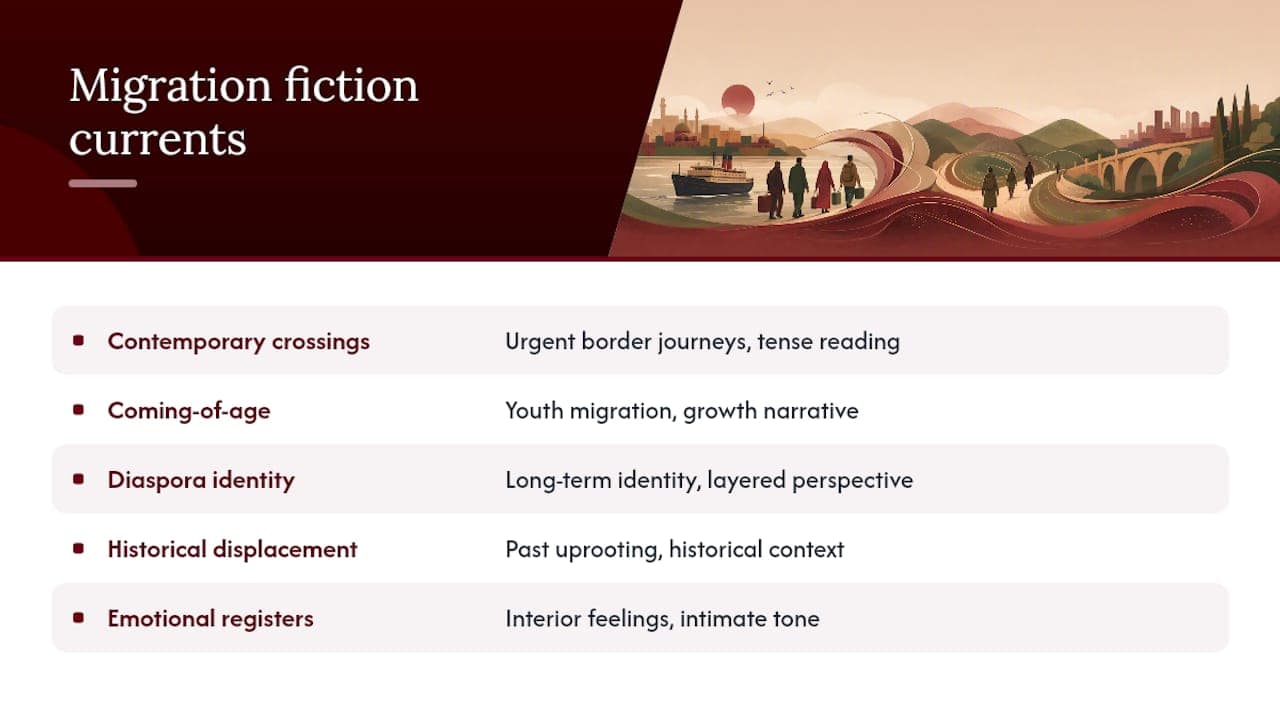
Refugee and forced migration
These books deal with people who didn’t choose to leave. War, persecution, or violence made the decision for them.
- What Strange Paradise by Omar El Akkad — A nine-year-old Syrian boy named Amir is the sole child survivor of a capsized smuggler’s boat. The novel alternates between his journey and his arrival on a resort island, where local kids decide to hide and protect him. It matters because it refuses to let readers stay comfortable spectators; it puts you on the boat.
- Exit West by Mohsin Hamid — Saeed and Nadia flee an unnamed city at war by stepping through mysterious black doors that deposit refugees around the globe. Hamid strips out the mechanics of border crossing to focus entirely on what displacement does to a couple’s love. It matters because it universalizes the refugee experience without erasing its specificity.
- Amnesty by Aravind Adiga — Danny, an undocumented Sri Lankan man in Sydney, spends one day deciding whether to tell police what he knows about a client’s murder, knowing it could get him deported. It matters because it dramatizes the impossible math of undocumented life: justice weighed against survival.
Diaspora and belonging
These novels follow people who’ve already migrated, or whose parents did, and are working out what “home” even means anymore.
- The Refugees by Viet Thanh Nguyen — Eight linked short stories about Vietnamese immigrants and refugees in California, spanning ghosts, estranged fathers, and a woman with dementia who mistakes a young man for her dead son. It matters because it captures the long tail of displacement, decades after the crossing itself.
- The World and All That It Holds by Aleksandar Hemon — Rafael Pinto, a Sarajevo pharmacist, is swept from the Bosnian city through the Austro-Hungarian army, Central Asia, and Shanghai, China, carrying a decades-long love story with him. It matters because it shows migration as a lifelong condition, not a single event with a clean ending.
- For readers drawn specifically to Caribbean and Black diaspora belonging, Maroon House Press publishes fiction built around exactly this tension between inherited memory and new ground; the Caribbean fiction catalog is a strong next stop after these titles.
Historical and internal migration
Not every migration story crosses an ocean. Some of the most wrenching displacement happens within a single country, driven by labor, colonization, or economic collapse.
- The Art of Losing by Alice Zeniter — Three generations of an Algerian family navigate the Algerian War of Independence, forced relocation to France, and the silence that follows trauma nobody wants to discuss. It matters because it shows how colonial rupture echoes for generations after the original displacement fades from headlines.
- The Year of the Runaways by Sunjeev Sahota — Three Indian men and one British-Indian woman converge in Sheffield, trapped in debt, exploitative labor, and immigration limbo. It matters because it details the economics of migration with a precision most novels skip: what it actually costs to get somewhere, and what it costs to stay.
- Readers wanting historical context for colonial-era displacement in the Caribbean specifically may find useful background in Maroon House Press’s piece on colonial education and Caribbean identity, which explains some of the systems that shaped generations of internal and outward migration from the region.
Contemporary migration and border crossings
Exit West anchors this category, but it’s worth noting how it treats the border itself. Hamid doesn’t dramatize walls, guards, or paperwork. He treats the crossing as almost incidental. That’s a deliberate choice; the novel is more interested in what happens after arrival than in how you got there. It’s available through Bookshop, which is worth knowing if you’d rather support an indie shop than a mega-retailer.

Coming-of-age and YA migration stories
Migration hits differently when you’re a kid or teenager who had zero say in the decision. YA and coming-of-age migration novels tend to focus on identity formation under pressure: new language, new school, old grief nobody else around you shares. If you’re building a reading list for a teenager, or you’re a teacher assembling a unit on displacement, pair one adult literary title from the lists above with a YA counterpart so students see both the interior adult reckoning and the adolescent version of the same disruption.

How to Choose the Right Migration Novel for You
Pick by three things: whose voice you’re reading, what kind of migration the book depicts, and what emotional register you’re in the mood for. A novel told in tight first-person, like Amnesty, puts you inside one consciousness for the whole book. A multi-voiced novel, like The Refugees, gives you range at the cost of depth in any single story.
Match the migration type to your curiosity. Forced displacement (What Strange Paradise, Exit West) reads differently than economic migration and labor exploitation (The Year of the Runaways), and both differ from generational diaspora reckoning (The Art of Losing, The World and All That It Holds).
Before you commit to a title, run through this quick checklist:
- Viewpoint — first-person intimacy or multi-voiced range?
- Migration context — forced flight, economic necessity, or colonial-era displacement?
- Tone — lyrical and interior, politically direct, or plot-driven?
- Era — contemporary crossing or historical displacement?
- Content notes — violence, detention, trafficking, or family separation depicted on the page?
Several of these titles depict detention, drowning, and human trafficking in direct terms. What Strange Paradise opens with a mass drowning. The Year of the Runaways includes exploitative labor conditions and violence. If those subjects are difficult territory for you right now, read a review or the first chapter before committing.
Pro Tip: Favor autofiction and own-voices narratives when you want lived texture over researched approximation. A writer working from personal or family history tends to render the small, unglamorous details of displaced life, like paperwork anxiety or code-switching at dinner, that outsider research often misses entirely.
Further Reading: Memoirs, Essays, and YA Migration Books
Fiction gives you interiority; memoir gives you the receipts. Reading both genres side by side rounds out what migration actually feels like versus what it actually costs in bureaucratic, financial, and legal terms.
Memoirs and essays:
- Personal narratives of undocumented or mixed-status family life add testimonial weight fiction can only approximate. Patricia Engel’s Infinite Country, though a novel, draws directly on the author’s own background to render mixed-status family life with the same granularity you’d expect from memoir, according to NEA Big Read materials.
Your own line:
- There’s a third thing these books tend to provoke, and it isn’t more reading. A fair number of people finish a generational migration novel and start wondering about their own crossings, which names went missing, and why nobody talks about a particular decade. If that’s where this list leaves you, tracing a family history runs into the same problem the fiction keeps circling: the archive recorded property carefully and people carelessly, and the gaps are where the story usually is.
YA and coming-of-age:
- Look for YA migration novels that focus on adolescent identity split between two cultures and languages. These complement adult literary fiction by showing the same disruption through a younger, less guarded lens.
Where to find these titles:
Independent bookstores, your local library, and Bookshop.org all carry strong migration-fiction selections and let you browse by theme rather than bestseller ranking. Buying through indie-friendly retailers also keeps a larger share of each sale with small booksellers instead of a single dominant online retailer.
A Publisher’s Perspective on Migration and Diaspora Fiction
Maroon House Press publishes Caribbean and Black diaspora fiction built around memory, migration, and cultural survival, and that focus shapes how the press thinks about which migration stories deserve shelf space.
The stories that get left out of the historical record are usually the ones told from inside a displaced community rather than about it. A migration novel earns trust the same way any testimony does: by letting the people who lived the crossing narrate their own reckoning, rather than handing that authority to an outside observer.
That conviction runs through the press’s catalog, particularly in fiction exploring how Caribbean communities carry inherited displacement (colonial-era, labor-driven, or diasporic) across generations. Readers who finish this list hungry for more region-specific migration fiction should look at Maroon House Press’s literary fiction catalog, where memory and movement are treated as inseparable subjects rather than separate genres.
What Actually Makes a Migration Novel Worth Your Time
Most reading lists on this topic treat migration novels as a single undifferentiated genre, as if a story about a Syrian refugee crossing the Mediterranean and a story about a British-Indian debt laborer in Sheffield are interchangeable because they both involve someone leaving home. They’re not. The conventional advice, read widely, read internationally, misses the sharper point: read for who’s holding the pen.
The strongest books on this list, Amnesty, The Year of the Runaways, The Art of Losing, share almost nothing in setting or plot. What they share is a refusal to let an outsider narrate the displacement. That’s not a stylistic preference. It changes what the book can actually tell you. A novel written from inside a community carries details, the specific shame of a rejected visa application, the particular grammar of code-switching, that research alone rarely surfaces.
If you take one thing from this list, prioritize author positionality before genre or setting. Ask who lived the crossing being described. That question will do more for your reading than any amount of geographic variety.
Find Your Next Migration Story With Maroon House Press
If the titles above left you wanting more stories where migration, memory, and identity are handled by writers working from inside those experiences, that’s exactly the gap Maroon House Press fills. Independent presses like this one specialize in exactly the kind of own-voices displacement narrative this list keeps circling back to, rather than the outsider-researched version bigger publishers sometimes default to.

Maroon House Press’s catalog centers Caribbean and Black diaspora fiction where migration, inheritance, and cultural survival aren’t separate themes bolted onto a plot. They’re the plot. That’s a different reading experience than picking up a bestseller list migration novel written by someone reporting on displacement from the outside. Browse the literary fiction catalog to find a Caribbean or diaspora migration story to read next, or start with the Caribbean fiction section if you want to go straight to region-specific titles.
Frequently Asked Questions
What are migration novels, exactly?
Migration novels are literary fiction centered on characters who move, willingly or by force, across borders, regions, or generations, exploring what displacement does to identity, family, and belonging. They differ from immigrant memoirs in that they’re invented narratives, though many draw heavily on lived or inherited experience.
What is the best migration novel to start with?
Exit West by Mohsin Hamid is the most commonly recommended entry point because it’s accessible, short, and treats displacement as a universal condition rather than a geographically specific one. From there, What Strange Paradise and The Refugees offer sharper, more particular perspectives.
Are there good migration novels focused on the Caribbean?
Yes. Caribbean migration fiction tends to focus on colonial-era displacement, labor migration, and diaspora identity across generations. Maroon House Press’s Caribbean fiction catalog is built specifically around these themes.
What’s the difference between diaspora fiction and migration fiction?
Migration fiction usually follows the act of crossing itself, the flight, the journey, the arrival. Diaspora fiction picks up afterward, following characters or their descendants as they work out identity and belonging in a new place, sometimes generations removed from the original move.
How do I research my own family’s migration story?
Start with the living people before you start with records. Interview the oldest members of your family first, then work backward one documented generation at a time. For Caribbean lines specifically, this guide to tracing family history covers which records exist, where they’re held, and what to do when the paper trail stops.
Do migration novels include difficult content like violence or detention?
Several do. What Strange Paradise opens with a mass drowning, and The Year of the Runaways depicts exploitative labor and violence tied to undocumented status. Check a synopsis or the first chapter if these subjects are hard territory for you right now.
Where can I buy these books and support independent bookstores?
Bookshop.org and IndieBound both list migration titles by ISBN and route your purchase through independent booksellers rather than a single large retailer.
Sources
- 21 Must-Read Books About Immigration | 2025 Update
- Voices Across the Empire: A Post-Colonial Reading of Amitav Ghosh’s Novels
- Bookshop
- NEA: Infinite Country — Patricia Engel