
Trinidad Folklore Books for Readers and Researchers
Start with six titles: Caribbean Folk Tales and Fantasies by Michael Anthony, Folklore Stories from Trinidad and Tobago by Al Ramsawack, Ti-Jean and His Brothers by Derek Walcott, Folklore & Legends of Trinidad and Tobago by Gerard Besson, Hungry Ghosts by Kevin Jared Hosein, and Caribbean Indian Folktales. Together they cover the two shelves you need: recorded oral tradition and folklore-rooted fiction.
The list below sorts these by type, since a collector’s compendium and a literary novel do very different work even when they share a character like Papa Bois or Soucouyant. A few are easiest to find through university library catalogs or Caribbean specialty booksellers; others sit on major retail platforms like Bookshop with standard shipping to most countries, ebook editions included.
- Caribbean Folk Tales and Fantasies — Michael Anthony
- Folklore Stories from Trinidad and Tobago — Al Ramsawack
- Ti-Jean and His Brothers — Derek Walcott
- Folklore & Legends of Trinidad and Tobago — Gerard Besson
- Hungry Ghosts — Kevin Jared Hosein
- Caribbean Indian Folktales — collected tales, tape-recorded from tradition-bearers
Key Takeaways
Trinidad folklore books split into two working categories: recorded oral collections and folklore-rooted fiction, and researchers get the most value from checking provenance before treating either as a primary source.
| Point | Details |
|---|---|
| Start with six core titles | Anthony, Ramsawack, Walcott, Besson, Hosein, and Caribbean Indian Folktales cover collections and fiction alike. |
| Know the six recurring figures | Papa Bois, Mama Dlo, La Diablesse, Soucouyant, Douen, and Lagahoo appear across nearly every collection. |
| Check provenance before citing | Look for a named collector, dated fieldwork, and documented tradition-bearers, as in Caribbean Indian Folktales. |
| Match the edition to your purpose | Academic editions suit research; popular retellings suit casual or classroom reading. |
| Explore fiction rooted in folklore | Maroonhousepress publishes Caribbean fiction that treats these figures as inheritance, available in ebook and paperback. |
Table of Contents
- Which Trinidad folklore books should you read first?
- What folklore characters should you look for in these books?
- Where do these stories come from?
- How do you choose the right edition or collection?
- Why does provenance matter for these collections?
- How should you approach these stories to understand them fully?
- Are there translated or multilingual editions of these books?
- Why does folklore matter to a Caribbean literary press?
- Where can you find folklore-rooted fiction from Maroon House Press?
- Sources
Which Trinidad folklore books should you read first?
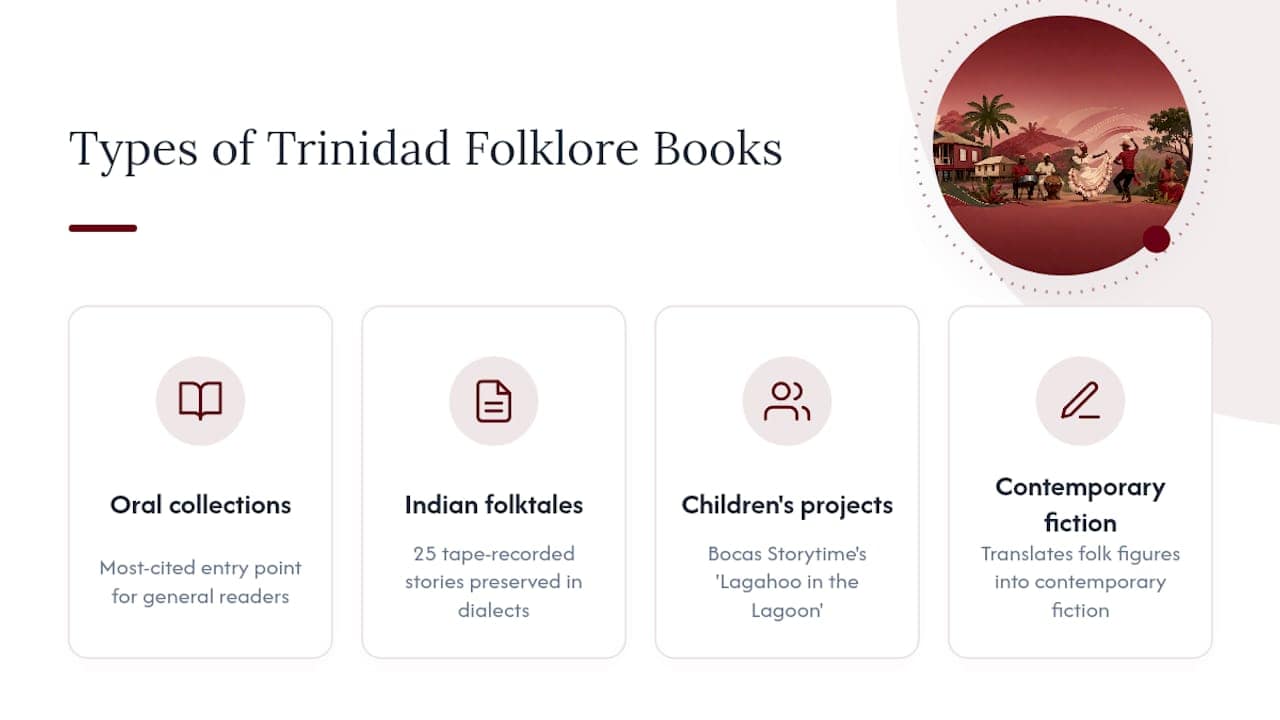
Trinidad’s folklore has never lived in one book. It survives in fragments, oral transmission, calypso lyrics, church-hall storytelling nights, and a scattering of print collections, some in print for decades, others self-published and harder to find. The titles below are grouped by what they actually do: preserve recorded tale-telling, document Indo-Caribbean narratives, support children’s and community storytelling, or translate these figures into contemporary fiction.
Traditional collections of Trinidad folktales
Michael Anthony’s Caribbean Folk Tales and Fantasies remains one of the most cited entry points for general readers. Anthony, a Trinidadian novelist known for his realist fiction set in the twentieth-century Caribbean, brings a novelist’s ear for voice to material gathered from oral tradition across several islands, not Trinidad alone, so readers researching specifically Trinidadian variants should cross-reference character entries against island-specific sources.
Al Ramsawack’s Folklore Stories from Trinidad and Tobago is narrower and more locally rooted, working through the core cast (douens, La Diablesse, soucouyants) with a storyteller’s directness rather than an academic apparatus. It reads well aloud, which matters if you’re using it with students or in oral-history-adjacent teaching.
Gerard Besson’s Folklore & Legends of Trinidad and Tobago, published by Paria Publishing (ISBN-10: 9768054476), functions as a compendium: creature by creature, with attributes and storytelling notes rather than continuous narrative. Besson has spent decades as a chronicler of Port of Spain and Trinidad’s cultural history, and this book reads more like a reference shelf than a story collection, useful for researchers who want quick verification of a character’s traits before they read a fictional treatment of the same figure.
Indian-origin Caribbean folktale collections
Caribbean Indian Folktales is a collection of 25 stories tape-recorded from tradition-bearers beginning around 1980, preserved in the storytellers’ own dialects rather than translated into standardized English. This matters for anyone tracing how Hindu-origin narratives entered Trinidadian oral tradition alongside African-rooted figures like Papa Bois and Mama Dlo, and how the two strands sit side by side in a single national folklore rather than in separate silos. The collection functions as a working textbook for researchers studying cross-cultural transmission in the Caribbean.
Children’s and community storytelling projects
Not every folklore text sits in a bound anthology. Bocas Lit Fest’s Storytime initiative produced “Lagahoo in the Lagoon,” a locally authored children’s story that shows how communities keep reshaping the Lagahoo for younger readers rather than treating the figure as fixed in a nineteenth-century text. It’s a small but telling example: folklore in Trinidad is still being written, not just archived.
June Lee-Sing Khan’s Moruga Tales draws on the specific folklore of the Moruga district in southern Trinidad and uses Trinidadian Creole selectively in character dialogue rather than throughout the prose. It’s a useful example for readers curious about how contemporary authors handle dialect without turning it into decoration.
Contemporary fiction that carries folklore figures
Derek Walcott’s Ti-Jean and His Brothers is the best-known literary treatment on this list, a play rather than a prose collection, built around a folk hero figure and staged with the devil as antagonist in a St. Lucian and broader Caribbean folk idiom that resonates strongly with Trinidadian tradition, as discussed in Literary Fiction: What Every Reader and Writer Needs to Know – SEM Publishing Ventures. Kevin Jared Hosein’s Hungry Ghosts, a literary novel set in rural Trinidad, works folklore into its texture rather than its plot mechanics, using the weight of belief and rural memory the way the best Caribbean fiction does: as atmosphere and inheritance, not costume.
Pro Tip: If you’re building a research bibliography, note the publication year and edition of every title separately from its first print run. Reprints sometimes drop or add editorial apparatus (glossaries, introductions), and citing the wrong edition can misattribute a scholarly note to the wrong editor.
What folklore characters should you look for in these books?
Six figures recur across nearly every collection and most folklore-rooted fiction on this list. Knowing them in advance makes the reading faster and the research sharper.
- Papa Bois: guardian of the forest and its animals, often depicted as an old man with horns or hooves; frequently invoked as a moral figure punishing hunters who take more than they need.
- Mama Dlo: a river spirit, half-woman and half-serpent, associated with waterways and often paired narratively with Papa Bois as consort or counterpart.
- La Diablesse: a beautiful woman with one human foot and one cloven hoof, said to lure travelers off forest paths at night.
- Soucouyant: a shape-shifting figure who sheds her skin at night to feed as a fireball, an Old figure with roots often traced to West African belief systems carried into the Caribbean through the transatlantic slave trade.
- Douen: the spirits of children who died unbaptized, appearing with backward-turned feet and wide-brimmed straw hats.
- Lagahoo: a shape-shifter, often described as a man cursed to transform into an animal, with contemporary retellings tracing the figure’s history to slavery-era narratives and its shifting cultural meaning since.
Several of these carry traceable roots: Soucouyant and related shape-shifting spirits echo Yoruba and broader West African cosmology, filtered through the Orisha tradition that survived and adapted in Trinidad. Douen and Papa Bois carry French Creole naming and phrasing layered over African source material. Collections tend to present these figures with fixed traits and cautionary framing; contemporary fiction usually complicates them, using the Lagahoo or Soucouyant to explore marginalization, desire, or displacement rather than warning.
Where do these stories come from?
Trinidadian folklore is not one tradition but several, woven together over centuries of forced and voluntary migration. The dominant layer traces to West African belief systems, particularly Yoruba cosmology and the Orisha tradition, carried by enslaved Africans and adapted to Trinidad’s landscape and Catholic overlay. A second major layer arrived later: Indian oral narratives brought by indentured laborers after 1845, preserved in collections like Caribbean Indian Folktales and existing alongside, rather than merging into, the African-rooted canon. A third layer, French Creole language and naming, shapes how many figures are described and titled, a legacy of Trinidad’s French planter class and the Creole vernacular that followed.
Most surviving collections came from fieldwork, not desk research. Collectors tape-recorded tradition-bearers directly, often working island by island or district by district, which is why edition notes matter so much to researchers: they tell you whose voice you’re actually reading.
- African/Orisha roots: Soucouyant, aspects of Papa Bois
- Indian oral arrivals: the tales in Caribbean Indian Folktales
- French Creole naming layer: La Diablesse, Douen, Lagahoo terminology
One especially documented case is the Gang Gang Sara legend from Tobago, read by some scholars as a story about the impossibility of return after enslavement, tied to salt, flight, and the loss of a way home.
How do you choose the right edition or collection?
Not every printing of the same title is equal, especially with older Caribbean folklore texts that have gone through multiple small-press runs.
- Check who collected or edited the material, and look for a stated methodology (fieldwork, tape-recording, named informants) rather than an unattributed “as told to” credit.
- Look for an introduction or provenance note explaining where and when the tales were gathered.
- Note whether dialogue is rendered in Trinidadian Creole or flattened into standardized English; this changes both the reading experience and the research value.
- Check for a glossary or footnotes if you’re not already fluent in the vocabulary.
- Verify the ISBN and edition year against a library catalog (WorldCat is reliable for this) before buying a secondhand copy, since some older Trinidadian folklore titles have gone through unlisted reprints.
Pro Tip: For classroom or research use, favor an edition with a named collector and dated fieldwork over a popular retelling with no provenance. For casual reading or gift-giving, the popular retelling is often the better, more readable choice.
Why does provenance matter for these collections?
Most credible Trinidad folklore books trace back to fieldwork, not invention. Collectors visited storytellers directly, recorded them, and transcribed their words with as much fidelity to dialect and rhythm as the print format allowed. Caribbean Indian Folktales is a clear example: its 25 stories were tape-recorded from tradition-bearers starting around 1980, a methodology that preserved not just plot but voice.
That kind of documentation is a trust signal in its own right. Before treating a collection as a research source, check for a named collector or editor, a stated date and location of fieldwork, and any archival cross-reference to a library or cultural institution.
A tape recording from a named tradition-bearer, dated and located, tells a researcher something an anonymous “as heard in Trinidad” retelling never can: whose memory this actually is.
- Publisher reputation and print history
- Editor or collector’s documented background
- Named informants or tradition-bearers where available
- Cross-reference to library or archival holdings
How should you approach these stories to understand them fully?
Read Trinidadian folklore as living belief carried through specific communities, not as a costume box of scary characters. Soucouyant, Lagahoo, and La Diablesse function in daily conversation the way parables function elsewhere: as warnings, moral frameworks, and ways of narrating danger, especially around forests, rivers, and unlit roads at night. Treat them with the same seriousness you’d bring to any belief system still practiced by living people, because in parts of Trinidad, these traditions still are.
It helps to read for function before you read for plot. Ask what a story is doing: warning children away from rivers, explaining a death, processing the aftermath of slavery, as scholars have read into the Gang Gang Sara legend, or working through anxiety about strangers on rural roads. The Yoruba and Orisha inheritance behind figures like Soucouyant is not decoration; it’s the actual belief system that shaped how these stories were told and why they persisted.
Read collections and fiction differently, too. A collection like Folklore & Legends of Trinidad and Tobago documents belief as it’s been described to a collector. A novel like Hungry Ghosts uses that same belief as atmosphere and inheritance inside a larger human story. Neither is more “authentic” than the other. They’re doing different jobs, and conflating them, treating a novel’s invented details as ethnographic fact, is the most common mistake researchers make with this material.
Are there translated or multilingual editions of these books?
Most Trinidad folklore titles are published in English, since English is Trinidad and Tobago’s official language, but the language layer inside the text is rarely simple English throughout. Many collections and novels shift into Trinidadian Creole for dialogue and direct speech, then return to standard English for narration, a pattern you’ll see in Moruga Tales and in much of Hosein’s Hungry Ghosts.
Few of these titles have been formally translated into other languages for international markets. Caribbean Indian Folktales is a partial exception: its stories were recorded in the tradition-bearers’ own dialects, which for some tales means Caribbean Hindi or Bhojwari-influenced speech patterns rather than English, preserved specifically to keep that linguistic layer intact rather than translating it away.
For readers outside the Anglophone Caribbean, the practical language barrier is usually vocabulary and rhythm rather than a different language entirely. A glossary or annotated edition helps considerably here, which is one more reason to check for scholarly apparatus before buying a copy. If you’re reading for research rather than pleasure, an edition’s handling of Trinidadian Creole tells you almost as much about its integrity as its provenance notes do. Skip any edition that flattens every character’s speech into uniform standard English; that’s usually a sign of an editor smoothing over the material rather than preserving it.
Why does folklore matter to a Caribbean literary press?
Folklore is memory doing the work that official records won’t. At Maroonhousepress, we publish fiction that treats figures like the Lagahoo and Soucouyant as inheritance, not spectacle, because they carry language, migration history, and identity the archive left out. Our catalogue makes room for that kind of storytelling on its own terms, through fiction, essays, and editorial context that take belief seriously.
Where can you find folklore-rooted fiction from Maroon House Press?
If you’ve read this far, you already know the gap: solid folklore collections exist, but literary fiction that uses Trinidadian and wider Caribbean folk figures with real craft, not tourist shorthand, is harder to find on general retail shelves. Maroonhousepress publishes exactly that kind of work, fiction rooted in memory, migration, and cultural inheritance, treated with the same seriousness Papa Bois or Mama Dlo deserve on the page.

Our Caribbean fiction catalogue includes novels and essay collections available in ebook and paperback formats, with direct purchase links on each title page. If you want to understand how authors handle Trinidadian Creole and dialect in fiction rather than in transcribed folklore, our piece on language and accent in Caribbean fiction is a useful next read. Browse the catalogue now and add a title to your shelf.
Sources
- Caribbean Folklore (Part 1)
- Caribbean Studies Association » Caribbean Indian Folktales
- Gang Gang Sara – Wikipedia
- Fables: The Lagahoo — Loop News
- Lagahoo in the Lagoon – Bocas Storytime