
Caribbean Gothic Novels for Scholars and Students
Caribbean Gothic reclaims the genre’s oldest devices, haunted houses, restless dead, cursed land, and points them back at colonial history itself. The mode uses supernatural and uncanny elements to register plantation violence, ancestral memory, and dispossession that never fully ended. Herbert G. de Lisser’s The White Witch of Rosehall remains the genre’s most-cited touchstone, alongside newer works like Maroon House Press’s Claimed by Water, Jean Rhys’s Wide Sargasso Sea, and Erna Brodber’s Myal.
What separates this from generic “tropical horror” is intent. The ghost is rarely there to scare you. It is there to testify.
Four formal signatures recur across the tradition:
- Landscape acts as a witness or agent, not backdrop
- Spectral figures demand justice, not just fright
- Ancestral voice interrupts linear, colonial time
- Folk cosmology sits alongside European Gothic furniture without apology
Key Takeaways
Caribbean Gothic uses ghosts, cursed land, and ancestral voice to hold colonial history accountable in ways the official record never did.
| Point | Details |
|---|---|
| Start with de Lisser | Read The White Witch of Rosehall first for the genre’s historical baseline, with a critical eye on its colonial framing. |
| Choose one theoretical frame | Pick postcolonial theory, memory studies, or folklore studies before drafting a thesis, rather than blending all five loosely. |
| Read supernatural elements as testimony | Treat hauntings as social memory and spectral justice, not atmospheric horror. |
| Pair old and new texts | Read a canonical work alongside a contemporary title like Maroon House Press’s Claimed by Water for a fuller genealogy. |
Table of Contents
- What Are the Origins of Caribbean Gothic Novels?
- What Themes Define Caribbean Gothic Fiction?
- How Does Form Shape Caribbean Gothic Storytelling?
- What Are the Best Caribbean Gothic Novels to Read?
- How Should Scholars Approach Caribbean Gothic Critically?
- Maroon House Press and the Study of Caribbean Gothic
- What Scholars Get Wrong About Caribbean Gothic
- Read Caribbean Gothic Fiction Published on Its Own Terms
- Sources
What Are the Origins of Caribbean Gothic Novels?
The genealogy runs in three rough waves. Nineteenth-century plantation fiction borrowed European Gothic conventions, crumbling great houses, mad mistresses, brooding landscapes, and grafted them onto real colonial estates. Early twentieth-century island novels then localized those conventions, embedding them in specific folklore and specific geography. By the late twentieth century, postcolonial writers were reworking the same tropes deliberately, turning the haunted house into a metaphor for the plantation system itself.
De Lisser’s 1929 novel sits at the hinge of the first two waves. It fictionalizes the legend of Annie Palmer, the “White Witch” said to have murdered husbands and enslaved people at Rose Hall estate in Jamaica, blending colonial-era travel writing, oral legend, and plantation archive into a single narrative. Scholars still return to it, though with a critical eye toward its own colonial-era biases and its treatment of enslaved characters as background rather than subject.
Folk cosmology supplies much of the raw material later writers draw on: duppies (restless spirits in Jamaican tradition), River Mumma (a water deity associated with rivers across Jamaica and the wider Caribbean), and the Annie Palmer legend itself function as archives in their own right, carrying testimony that plantation records omitted.
The chapter on colonial and postcolonial Gothic in The Cambridge Companion to Gothic Fiction argues that Gothic modes are used specifically to register colonial histories and the politics of horror within postcolonial contexts, not simply to produce atmosphere.
For anyone doing original research, a few practical notes matter:
- Plantation ledgers and estate records (often held in UK and Caribbean archives) supply names and dates that folklore later reworks into legend.
- Colonial travel writing frequently records folk beliefs secondhand, filtered through an outsider’s fear, so read it against local oral history where possible.
- Comparative volumes like Tropical Gothic in Literature and Culture: The Americas map Gothic forms across the hemisphere, but the Caribbean’s specific history of displacement and creolization deserves its own frame rather than a hemispheric average.
What Themes Define Caribbean Gothic Fiction?
Haunting in this tradition functions as social memory rather than jump-scare mechanics. A ghost that will not leave a cane field is rarely a random specter. It is usually the unfinished business of slavery, indenture, or land theft, refusing to be filed away as history.
Land and water recur as witnesses with agency of their own. A river that floods on the anniversary of a drowning, a great house that will not stay renovated, these aren’t decoration. They are the text’s way of insisting the past is not past. Maroon House Press’s Claimed by Water builds its entire structure around this idea, using river memory and ancestral inheritance to trace a Jamaican family’s forbidden history back through generations.

Spectral justice is the mode’s sharpest recurring move: a haunting that corrects, or at least names, a wrong the legal record never addressed. Annie Palmer’s ghost, as it circulates in Jamaican legend and in de Lisser’s novel, punishes cruelty the plantation system itself protected. Creolization shows up formally too, in the blending of European Gothic furniture (crumbling manors, family curses) with distinctly Caribbean cosmology, so that the two traditions stop being separable.
A short reading of two texts side by side shows the pattern clearly:
- The White Witch of Rosehall: the haunted estate becomes a site where colonial cruelty outlives the colonizer, filtered through folk legend about a real historical figure.
- Claimed by Water: a river’s long memory becomes the mechanism by which a family confronts what was hidden from them, folding water folklore into contemporary family drama.
Pro Tip: Resist reading the supernatural in these novels as genre flavor. Ask instead what specific historical debt the haunting is naming, then trace how the narrative resolves, or refuses to resolve, that debt.
As editorial commentary on the genre often notes, Caribbean Gothic tends to treat supernatural elements as lived, present-day realities that articulate suppressed histories, rather than as atmospheric embellishment layered onto an otherwise realist plot.
How Does Form Shape Caribbean Gothic Storytelling?
The mode’s politics live as much in sentence-level choices as in plot. A handful of techniques recur often enough to count as signatures:
- Fragmented, nonlinear timelines that refuse colonial history’s tidy chronology
- Oral storytelling frames, where a narrator retells a legend rather than simply narrating events
- Code-switching between English and Caribbean creoles, often without translation
- Landscape rendered with sensory, embodied language rather than flat description
These choices do real interpretive work. Consider three effects in sequence:
- A fragmented timeline forces readers to feel historical rupture rather than just read about it.
- An oral frame (a grandmother’s story, a village legend retold) signals that the text values folk transmission as much as documentary evidence.
- Untranslated creole dialogue asserts that some meaning belongs to insiders, refusing the colonial demand for full legibility.
The genre also mixes forms that usually stay separate: historical fiction’s research, Gothic’s atmosphere, and folklore’s structure of warning and consequence. That hybridity means a purely formalist Gothic reading (haunted house, unreliable narrator) will miss half the text’s argument. A purely historical reading misses the other half.
What Are the Best Caribbean Gothic Novels to Read?
Any serious reading list has to start with the touchstone and then branch into the bridge figures and contemporary voices who reworked it. The annotations below are built for quick reference, not exhaustive review.
- The White Witch of Rosehall (Herbert G. de Lisser, 1929): the foundational plantation Gothic, built around the Annie Palmer legend at Rose Hall estate. Essential but requires critical reading for its colonial-era treatment of enslaved characters.
- Tropical Gothic in Literature and Culture: The Americas (edited volume, Justin D. Edwards and Sandra G. T. Vasconcelos): the key theoretical anthology for situating Caribbean Gothic within hemispheric Gothic studies; consult its essays on plantation memory and transnational Gothic form.
- Wide Sargasso Sea (Jean Rhys, 1966): the essential bridge text, reworking Jane Eyre from a Creole heiress’s perspective and reframing the “madwoman in the attic” as a colonial casualty.
- Myal (Erna Brodber, 1988): folds Jamaican spirit possession and zombification into a story about cultural recovery from colonial education.
- Claimed by Water (Maroon House Press): a contemporary ancestral Gothic novel centering river memory and inherited family secrets, useful as a teaching pair with older plantation Gothic.
- Swift River (Maroon House Press): ties Jamaican flood history to a ghost narrative, useful for courses linking environmental history and Gothic form. Read more in this case study on Swift River.
- The Dragon Can’t Dance (Earl Lovelace, 1979): not Gothic in the strict sense, but useful for its treatment of Trinidadian folk ritual and inherited trauma.
- Krik? Krak! (Edwidge Danticat, 1995): Haitian short fiction that treats spirits and the dead as active participants in family and political memory.
| Title | Author/Publisher | Why It Matters |
|---|---|---|
| The White Witch of Rosehall | Herbert G. de Lisser (1929) | Founding plantation Gothic text, Annie Palmer legend |
| Wide Sargasso Sea | Jean Rhys (1966) | Bridge text reworking English Gothic from a colonial perspective |
| Claimed by Water | Maroon House Press | Contemporary ancestral Gothic, river memory and inheritance |
| Tropical Gothic (edited volume) | Edwards and Vasconcelos | Core theoretical anthology for hemispheric framing |
How Should Scholars Approach Caribbean Gothic Critically?
Five frames dominate serious criticism of the genre, and most strong essays combine at least two.
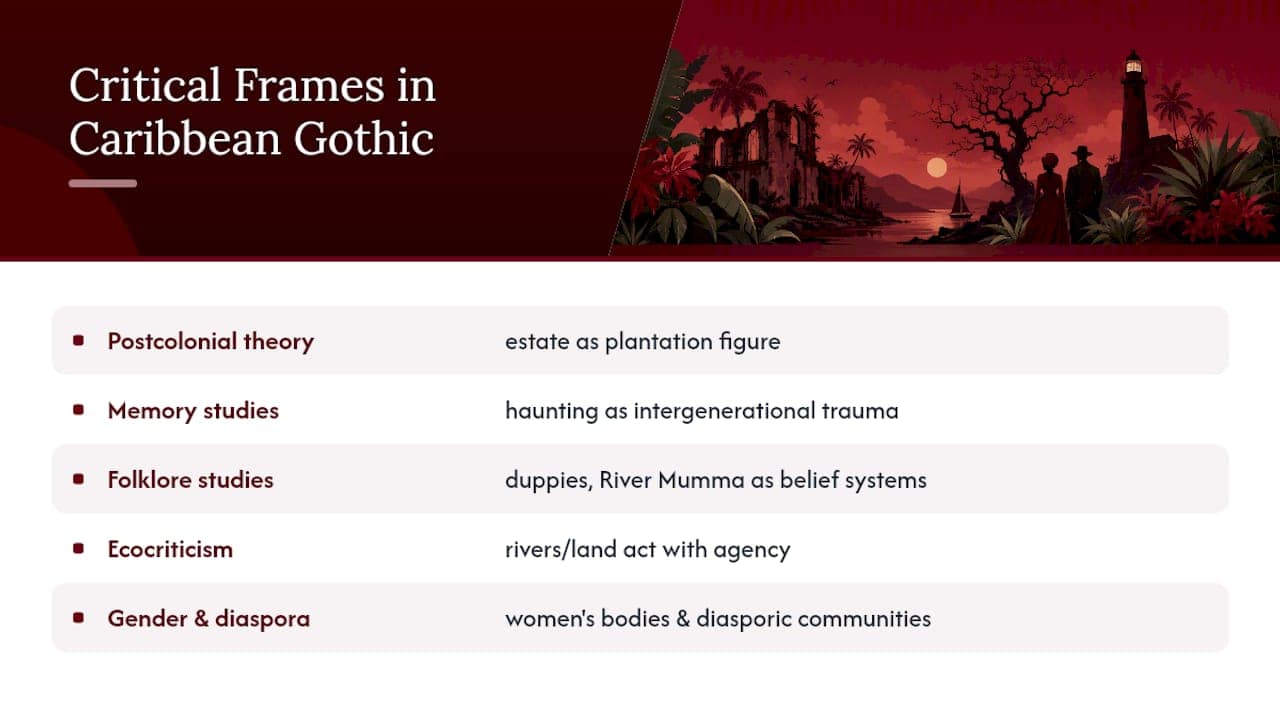
Postcolonial theory reads the haunted estate as a figure for the plantation economy itself, asking what the ghost demands of the present. Memory studies treats haunting as a transmission mechanism, tracking how trauma moves across generations when official records suppress it. Folklore studies takes duppies, River Mumma, and similar figures seriously as belief systems with their own internal logic, not as literary borrowings. Ecocriticism asks what it means for rivers, forests, and land itself to act with agency in these texts. Gender and diaspora studies examine how women’s bodies and displaced communities carry the genre’s central hauntings, from Rhys’s Antoinette to contemporary migrant narratives.
Strong research questions follow from combining frames: How does a specific novel’s haunting map onto a documented historical event? What does the text’s folklore source (oral history, colonial travel writing, or invented composite) reveal about its politics?
The DOI-indexed Cambridge Companion chapter remains the most citable starting point for situating any individual Caribbean Gothic text within the broader colonial and postcolonial Gothic framework.
Maroon House Press and the Study of Caribbean Gothic
Maroon House Press publishes fiction and nonfiction rooted in Jamaica, the wider Caribbean, and the Black diaspora, with a catalogue built specifically around memory, inheritance, and folklore rather than imported genre templates. The press’s Caribbean fiction catalogue functions as a working archive for exactly the kind of contemporary Gothic writing this article maps.
Two titles stand out for coursework. Claimed by Water pairs naturally with The White Witch of Rosehall in a syllabus unit on water, memory, and inherited secrets. Swift River works well alongside ecocritical readings, since it ties a specific flood history to its haunting rather than using water as generic atmosphere.
Pro Tip: When assigning Maroon House Press titles, open discussion with a ritual or memory object in the text (a river crossing, a name withheld) rather than the plot’s supernatural event. Students engage more critically when the ghost is treated as a question, not a twist.

What Scholars Get Wrong About Caribbean Gothic
The conventional shorthand, treating this as “tropical horror” or a regional subset of magical realism, undersells the genre’s actual argument. Caribbean Gothic isn’t borrowing eerie atmosphere from a warm climate. It’s a deliberate return of Gothic form to the exact sites that produced colonial horror in the first place: the plantation, the river, the great house.
Where I think the field still underestimates its own material is in folklore. Duppies and River Mumma get treated too often as local color dressing up a Western Gothic skeleton, when they function as independent memory systems that predate and outlast the colonial archive. Read them as testimony, not seasoning, and entire novels reorganize around that shift.

If you’re building a syllabus or a thesis, prioritize texts that let spirits act as political agents rather than props. That’s where Maroon House Press’s contemporary catalogue earns its place alongside de Lisser: not as a modern update, but as a continuation of the same reckoning.
Read Caribbean Gothic Fiction Published on Its Own Terms
Most academic presses treat Caribbean Gothic as a subset of a larger tradition, filed under postcolonial studies or hemispheric Gothic surveys. Maroon House Press does something different: it publishes the fiction itself, centering Caribbean spiritual traditions and ancestral memory without translating them for an outside reader.
If you’re building a course or a research list, the Caribbean fiction catalogue gives you primary texts written from within the tradition rather than about it, including Claimed by Water and Swift River, both referenced above. For a deeper look at how the press thinks about language and register in Caribbean writing, the essay on language, power, and accent in Caribbean fiction is worth assigning alongside any close-reading unit. Start at the Maroon House Press catalogue to browse current titles and add the next primary source to your reading list.
Sources
- Colonial and postcolonial Gothic (Chapter 12)
- DOI for Cambridge Companion chapter
- Tropical Gothic in Literature and Culture: The Americas
- The White Witch of Rosehall (Herbert G. de Lisser)