Caribbean & Diaspora Storytelling
Reading list
Colonial education in the Caribbean: eight books on what school did to us
One history, six novels and memoirs, and the essay that explains the rest. The books that show what it meant to be a Caribbean child taught to be English, and what the writers who came out of those classrooms made of it.
Every Caribbean writer of the last century went to a colonial school. Most of them have been writing about it ever since.
In Jamaica the system took shape after emancipation in 1834, when the churches, with a British grant behind them, built elementary schools to make the newly free into orderly, literate, Christian laborers. Fees for elementary schooling were abolished in 1892. Above that sat a small number of secondary schools, some of them very old, that prepared a narrow class of children for the Cambridge examinations and, for a very few, for a university in England. The curriculum at every level was British: English kings, English poets, English weather. Patois was corrected. The island’s own history, Maroon and African and Scottish and Indian, was not on the syllabus.
The results were contradictory, and the contradiction is the subject of this list. Colonial schooling produced the generation that won independence and the writers who told the rest of the world what the Caribbean was. It also taught several generations of children that their own speech, food, religion and family were things to be grown out of. Both things are true, and the books below hold them together better than any argument can.
We have put one history first so the fiction has a frame, then the novels and memoirs in roughly the order of the childhoods they describe, and one essay from outside the Caribbean at the end, because it says plainly what the others dramatize.
The list
Eight books, in order
The one straightforward history of the Jamaican system, from the emancipation-era church schools through the teacher-training colleges and the secondary schools to the eve of the modern era. Out of print, so copies are secondhand, but it remains the book that tells you what school your great-grandmother could and could not have attended, and who paid for it.
The foundational Caribbean novel of boyhood, set in a Barbadian village in the 1930s and 1940s. Its schoolroom scenes, the Empire Day parade, the headmaster, the boys learning the lineage of English kings, are the ones every later writer is answering. Lamming shows the village and the school as two different countries and the child as the border between them.
Short, funny and merciless. Tee is raised by her Tantie in a loud, loving, Creole-speaking household, wins a scholarship, and is handed over to her Aunt Beatrice to be made respectable. The novel’s whole argument is in the way Tee’s own voice changes as the schooling takes. If you give one book on this list to a teenager, give this one.
Jamaica, 1958, four years before independence. Clare Savage is twelve, light-skinned, and being educated at a Kingston girls’ school into a version of history that leaves out her own: the Maroons, Nanny, the estate her white ancestor owned and the people he held on it. Cliff sets the schoolbook history and the island’s real history side by side and lets the reader watch them fail to match.
Senior’s first collection, told mostly through the eyes of rural Jamaican children caught between the yard and the demands of school, church and “good” relatives. Nobody has written better about the particular loneliness of the bright country child sent to be improved. Winner of the Commonwealth Writers’ Prize.
The poet’s account of her mother’s people in Harvey River, Hanover, and of the world of early twentieth-century rural Jamaica in which schooling, church and respectability were the family’s whole strategy for rising. It is the memoir on this list, and the gentlest, and it belongs beside the novels because it shows what the system looked like to the people who believed in it.
Eighty pages of controlled fury about Antigua, addressed to the tourist, in which the colonial school and the ruined public library stand for everything else. Kincaid was taught to love English literature in English and says so, and then says what that cost. The most quoted book on this list, and the one that makes the argument the novels leave implicit.
Not Caribbean, and here on purpose. Ngũgĩ’s account of being punished at school for speaking Gĩkũyũ, and of what it means for a people to be educated out of their own language, is the clearest statement anywhere of what the Jamaican child corrected for speaking Patois was being taught. Read it last and the other seven come into focus.
From the House
And one ghost story from the same classroom
Not on the list of eight, because it is ours. But if the list has done its work, this is the novel to read next.
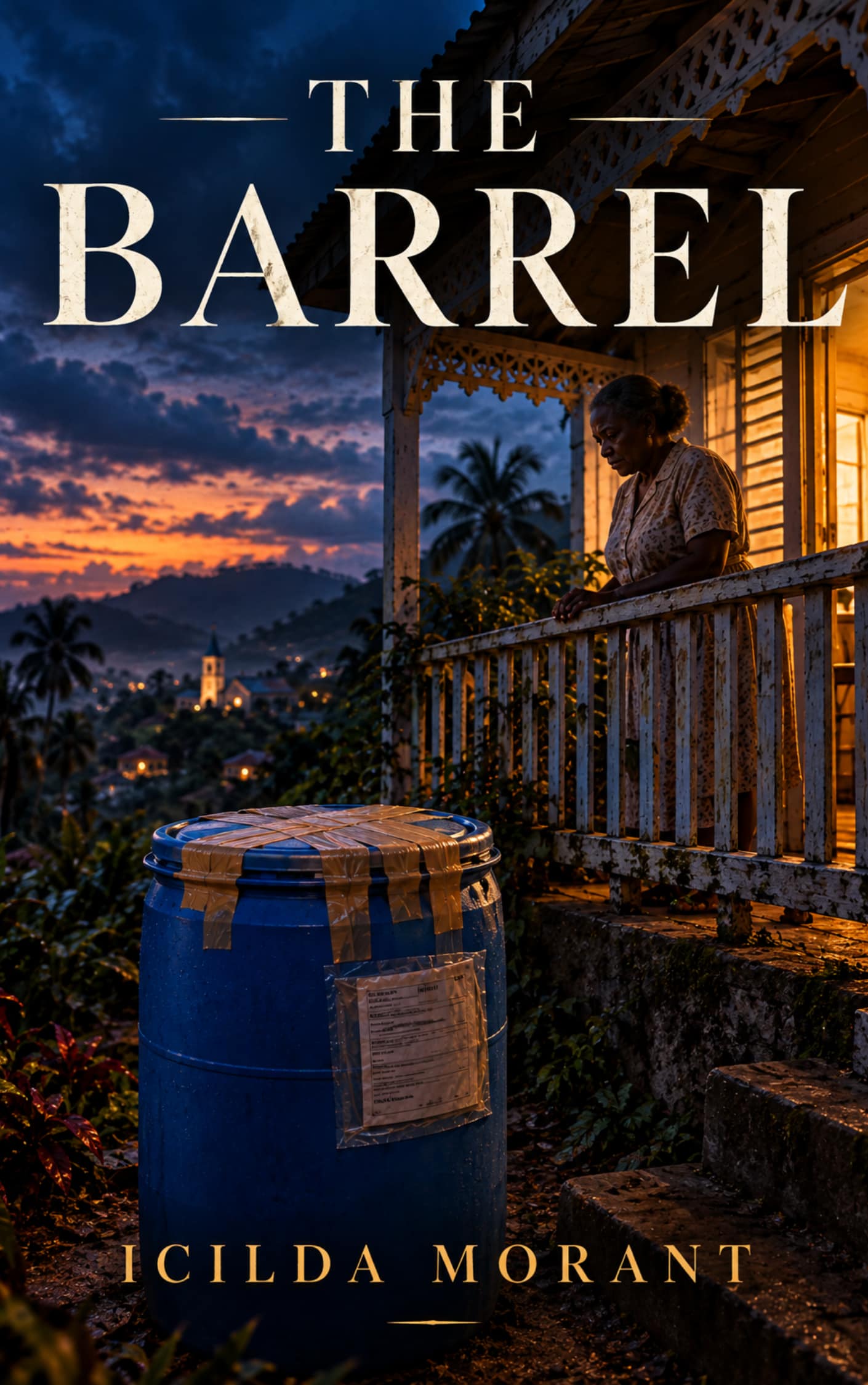
Every Christmas for twenty years, Desmond Morris shipped a barrel home to Jamaica. He died in March. In December, a barrel still arrives at his sister Enid’s gate in the hills of St. Thomas, holding four parcels: a school tie, a child’s copybook, a ruler with a chip in its edge, and a book of poems every Jamaican child once had to recite by heart.
Enid is the one who stayed. In 1963 she came first in the whole parish, and the letter that would have changed her life never arrived. The Barrel is what the colonial classroom looks like when it comes back to collect.
Maroon House Press is an Amazon Associate. Purchases made through links on this site may earn the press a commission at no extra cost to you.
Why this matters for family history
Two reasons. The first is practical: between emancipation and independence, school was the institution most likely to write a Jamaican child’s name down. Elementary school registers, teacher-training college lists, scholarship announcements in the Gleaner and the records of the church that ran the school are among the richest sources for a family in that period, and many survive in the Jamaica Archives in Spanish Town or in the archives of the denominations themselves.
The second is about the interview. The elders you sit down with were schooled in this system, and the pull between the speech of the yard and the speech of the classroom is still in them. It explains why a grandmother answers in careful English and then, an hour in, tells the real story in Patois; why some subjects are “not for talking about”; and why the question “what did they teach you about Jamaica at school” so often opens a door that “tell me about your childhood” does not. Our starter kit covers what to have on hand for those conversations, and Read the Names covers where the records are.
Everything Maroon House publishes in this territory is on the Caribbean fiction and literary fiction shelves.
Frequently asked questions
What was colonial education in Jamaica?
The school system built in Jamaica under British rule, from the church-run elementary schools that followed emancipation in 1834 to the fee-paying secondary schools and Cambridge examinations that shaped the island’s professional class into the twentieth century. It taught English history, English literature and English speech to Jamaican children, and its effects outlasted independence in 1962.
What is the best novel about colonial schooling in the Caribbean?
Merle Hodge’s Crick Crack, Monkey is the sharpest and shortest; George Lamming’s In the Castle of My Skin is the foundational one. For Jamaica specifically, Michelle Cliff’s Abeng.
Why does this matter for family history?
School records, teacher-training registers and scholarship lists are among the richest surviving sources for Jamaican families between emancipation and independence, and the pull between home speech and school speech explains a great deal about what elders will and will not say in an interview.
The Maroon House Reader
First look at every new title, straight from the publisher’s desk.
Excerpts before release, notes on what we’re acquiring, and the occasional dispatch from Jamaica. Sent when there’s something worth sending.
One email at a time. Unsubscribe whenever you like.